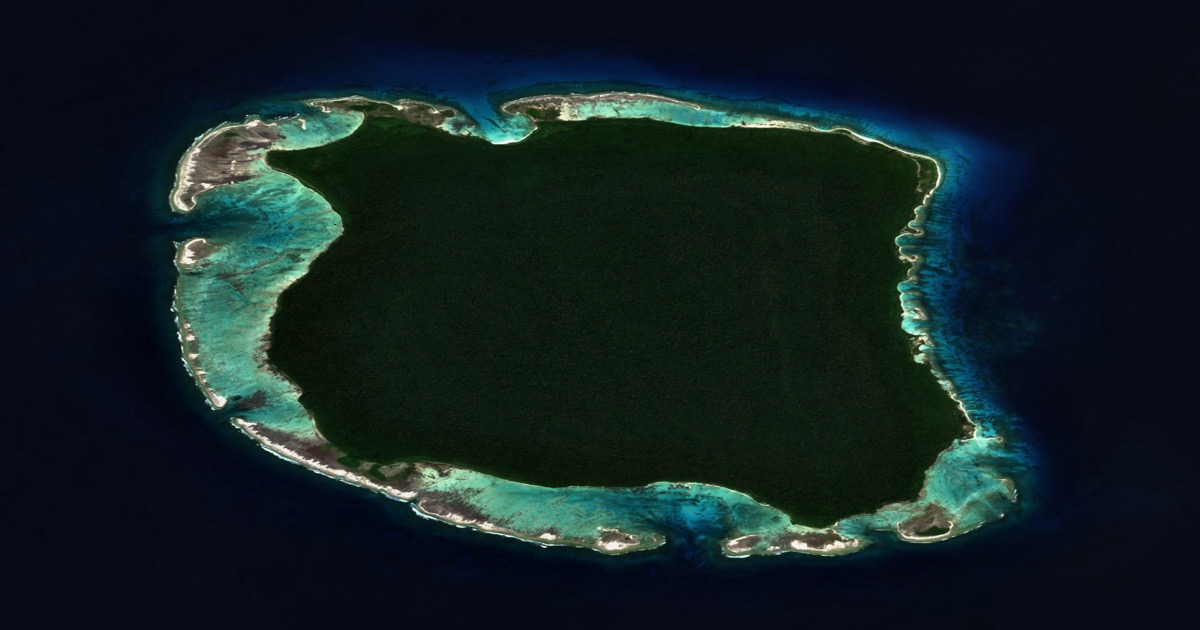
At the eastern end of the Andaman Sea, about 36 kilometers off the coast of Wandoor, stands North Sentinel Island: a piece of rainforest about 60 square kilometers that remains one of the few places on the planet where modern civilization has not entered. It is home to the Sentinelese people, considered the most isolated indigenous group in the world, and the Government of India has maintained the island and its waters as off-limits territory for decades.
Where is it and what is it like?
The island is part of the union territory of Andaman and Nicobar, administered by India. Its approximate coordinates are 11°34′N, 92°14′E. According to Wikipedia, it is about 7.8 km long and 7 km wide, with a coral coast surrounding it and a summit of about 122 meters. Images from the Sentinel-2 satellite and the NASA Earth Observatory show an almost square profile: dense forest in the interior and a ring of raised reef after the 2004 earthquake.
Commercial flights between Port Blair and the mainland often fly over the island – without landing or approaching the coast – and passengers have recorded the view from the window. In August 2025, the account @maniaUFO broadcast on X an aerial clip that went viral: a plane crossing over the North Sentinel jungle.
Video: plane flying over North Sentinel Island
Images from a commercial flight over the forbidden island: dense forest and perimeter reef seen from the window. Source: @maniaUFO — X (Aug 19, 2025)
The Sentinelese people
The Sentinelese have been on the island for thousands of years without sustained contact with the outside world. They speak a language unrelated to the neighboring Andaman languages and subsist on hunting, fishing and gathering. According to the Indian Press Information Bureau, the group remains isolated, practicing a “primordial” way of life of hunting and gathering.
Survival International describes them as the most isolated indigenous people on Earth: they consistently reject contact with strangers and have responded with hostility to those who approach without authorization. Their language and exact number are not known; The last official census that attempted to count them dates back to 2001 (39 people), and since then India has given up counting them so as not to interfere.
Why India prohibits approaching
Protection is not a bureaucratic whim: it responds to two intertwined risks — the survival of the people and the safety of intruders.
- Immunity: having no contact with the outside world, the Sentinelese lack defenses against common diseases (flu, measles, tuberculosis). On other Andaman islands, forced contact with isolated tribes has caused devastating epidemics in the past.
- Autonomy: the Indian government respects their way of life and has abandoned attempts to "civilize" or integrate them.
- Defensive violence: the tribe has attacked approaching boats and people; several fishermen and an American missionary have died in unauthorized contact attempts.
The regulation that protects it is the Andaman and Nicobar Islands (Protection of Aboriginal Tribes) Regulation, 1956, complemented by laws on scheduled castes and tribes and the Indian Forest Act. The entire island and up to 5 km of sea from the high tide line are notified as a tribal reserve, according to the PIB.
Eyes-on, hands-off policy
Since the 1990s, India has applied a no-knock policy: ships from the Coast Guard, the maritime police and sometimes the Navy patrol around the island to detect intruders, but do not disembark or attempt to establish contact. The PIB sums it up like this: «eyes-on and hands-off» to protect the Sentinelese people.
For local fishermen, the waters rich in fish and sea turtles are tempting; For the administration, any approach can trigger a confrontation or—worse—an epidemic. The rule is simple: do not approach, do not contact.
Incidents that reinforced the closure
In November 2018, the American missionary John Allen Chau paid fishermen to illegally approach the island. He was killed by members of the tribe; His remains were not recovered and the case reinforced the government's stance of zero tolerance for adventure tourism and proselytism.
Years earlier, in 2006, two Indian fishermen sleeping near the coast were murdered when their boat became stranded. In both cases, the authorities did not attempt to punish the tribe: the official message was that the responsibility falls on those who violate the prohibited zone.
Recent case: fishermen arrested in March 2026
Surveillance is still active. According to Nicobar Times, on March 1, 2026 a fishing boat was found anchored off the coast of North Sentinel Island. The South Andaman district police registered a case at Humfrygunj police station against Mahesh Mundari and Ravi Ram Naskar, residents of Wandoor, for entering tribal reserve waters where fishing and landing are prohibited.
The incident illustrates that, more than half a century after the 1956 law, the island remains a magnet for those who underestimate the risk — and that India maintains criminal mechanisms to deter them.
Video: the dilemma of protecting the Sentinelese people
DW News reviews the Indian exclusion policy and recent attempts at illegal contact with the tribe. Source: DW News (YouTube)
Can you visit one day?
No, except for exceptional authorization from the territorial administration, which is practically not granted. There are no hotels, airports or tourist infrastructure; commercial flights do not fly over the island for recreational purposes and travel agencies do not offer excursions. News18 summarizes the current position: the way The safest and most responsible way to “engage” with North Sentinel Island is to stay far away.
For anthropologists and the curious, the island functions as a reminder that not every territory must be colonized, measured or integrated. For the Sentinelese people, isolation is not a backwardness: it is their choice and their shield. And for India, protecting them is also protecting anyone who might believe that adventure is worth more than the lives of others.
Most read
What readers are engaging with right now.
- Culture
Goose, the gay app that competes with Grindr, reaches the top 4 of Lifestyle in the App Store

- World
Cubans protest in Miami against Airlines Connections for alleged scam: they demand up to $20,000 in packages to Punta Cana

- World
Trump declares the ceasefire with Iran over, orders new attacks in Hormuz and demands cutting trade with Spain in NATO

- Culture
Harry Potter on HBO: complete guide to the series (not yet released and already renewed for T2), dates, cast and controversies

- Culture
DUK App: Aly Sánchez launches her habits app "one day at a time" with a 63-day program
- Culture
I'm Edgy and Edgy Labs: From Nebraska's Walmart to a beef tallow cream brand that sells across the US.

- Culture
The Evening of the Year VI: all the winners, fights and performances of the Ibai night in Seville

- World
The FBI is investigating the AFA for alleged fraud and money laundering: about $300 million in sponsorships and operations in the US.

- World
El Cangrejo: profile of Raúl Guillermo Rodríguez Castro, Raúl Castro's grandson between GAESA, leaked luxuries and the first interview of 2026