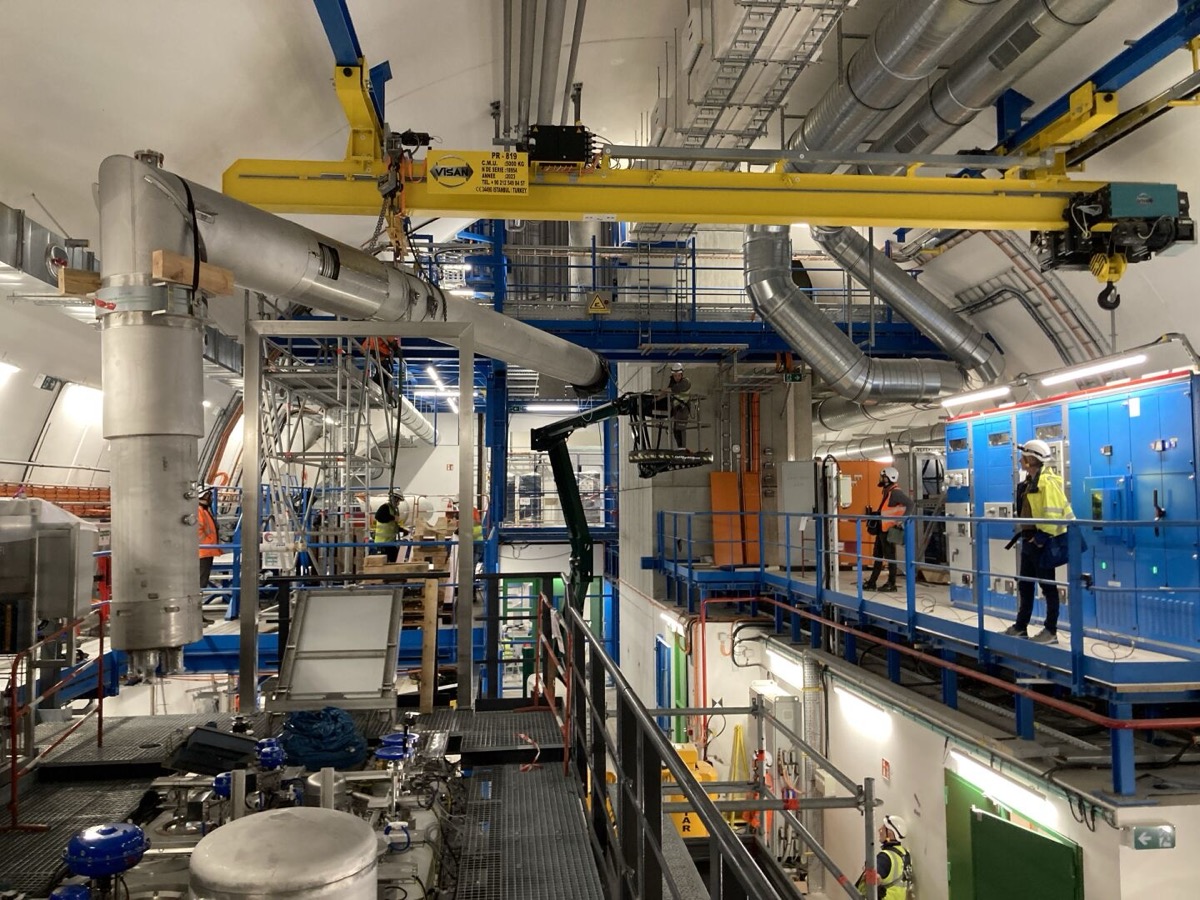
On June 29, 2026, CERN shut down the Large Hadron Collider (LHC) after its final physics season. It is not a definitive closure or an escape from the apocalypse: it is the beginning of Long Shutdown 3 (LS3), the largest transformation of the accelerator since its construction, to be reborn in 2030 as HiLumi LHC (High-Luminosity LHC). While social networks mix science with dimensional portals and the "God particle", thousands of engineers dismantle 1.2 km of superconducting magnets under Geneva. This guide separates verified facts, tangible benefits for humanity, real risks and conspiracy myths surrounding the most famous laboratory in the world.
Video: What does HiLumi mean? (CERN official)
CERN explains the high luminosity project that motivates the four-year blackout. Source: YouTube — CERN
What exactly happened on June 29
On Saturday June 27 at 6:00, LHC operators discharged the last proton beams. Two days later, the throttle was officially taken out of service for the LS3. During the last "season" of 2026, the ATLAS, CMS, ALICE and LHCb experiments recorded collisions of protons and lead ions, including high-intensity beam tests to prepare for HiLumi.
According to CERN, LS3 is the most extensive intervention since the LHC was built. It implies:
- Remove and replace 1.2 km of magnets and components of the 27 km ring.
- Install more powerful superconducting focusing magnets and new technical galleries.
- Completely renew the ATLAS and CMS detectors (new firing systems, silicon trackers, calorimeters).
- Consolidate injectors, the SPS synchrotron, ISOLDE and laboratory electrical networks.
The other CERN accelerators continued to operate until the end of August 2026; then they also come to a stop. The complex will be reactivated gradually from 2028; the HiLumi LHC should produce physics collisions in June 2030.
What is CERN and what the LHC does
The European Organization for Nuclear Research (CERN), founded in 1954 near Geneva, does not only investigate atomic nuclei: it is the largest particle physics laboratory on the planet. The LHC is an underground ring of 27 kilometers where protons (or heavy ions) accelerate almost to the speed of light and collide head-on at four points where the detectors are.
The goal is not to "create universes" or open portals, but to reproduce extreme conditions in the laboratory -- energies and densities similar to those of the early universe -- to measure what comes out of the collisions and contrast it with the Standard Model, the theory that describes elementary particles and three of the four fundamental forces.
The Higgs boson: what it is and why they call it the "God particle"
On July 4, 2012, ATLAS and CMS announced the discovery of the Higgs boson, predicted in the 1960s by Peter Higgs, François Englert and others. He confirmed the mechanism by which elementary particles acquire mass by interacting with the Higgs field, an invisible "broth" that permeates the universe.
Physicists do not use the nickname "God particle." It comes from the title of Leon Lederman's book (The God Particle, 1993) — a media label that Lederman himself admitted was provocative. In the scientific community we simply speak of Higgs boson or scalar particle.
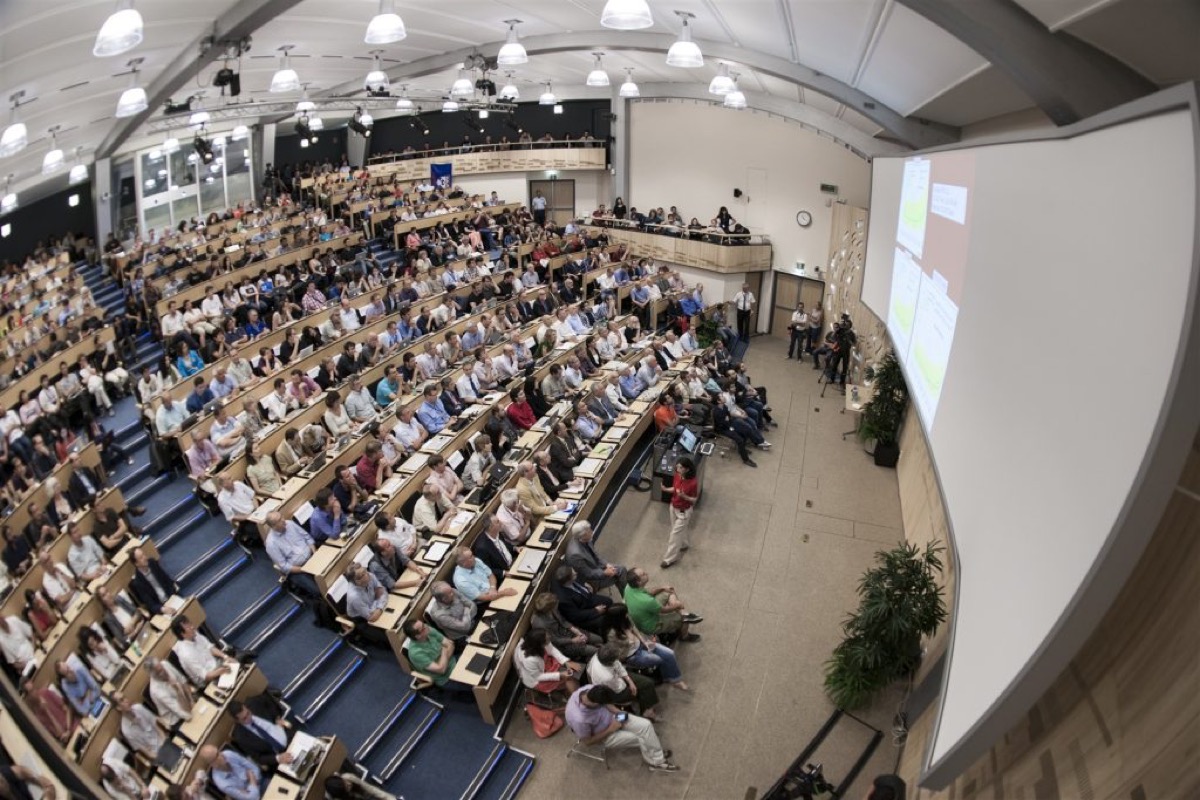
Higgs and Englert received the Nobel Prize in Physics 2013. Since 2012, the LHC has refined the properties of the boson (mass ~125 GeV/c², spin 0, positive parity). But the Standard Model remains incomplete: it does not include gravity, it does not explain dark matter or why there is more matter than antimatter.
What is investigated (and what is sought with HiLumi)
| Line of research | What are you looking for | Why HiLumi matters |
|---|---|---|
| Precision Higgs | Measure couplings of the Higgs with other particles | ×10 collisions → sufficient statistic for rare processes |
| Double Higgs | Two Higgs bosons produced and interacting at the same time | HL-LHC “Star Target”; reports on the Higgs field itself |
| Physics beyond the Standard Model | Supersymmetry, extra dimensions, new particles | More data = sensitivity to signals that the current LHC did not achieve |
| Dark matter | Invisible particles that make up ~27% of the cosmos | More frequent collisions improve candidate searches (WIMPs, etc.) |
| Antimatter / CP | Matter-antimatter imbalance in the early universe | LHCb and ALICE experiments with lead-lead |
| Quark-gluon plasma | State of matter microseconds after the Big Bang | ALICE recreates primordial “soup” in heavy ion collisions |
The Register summarizes the HiLumi's goal: to produce about 380 million Higgs bosons throughout their operational life, compared to around 55 million since 2008. This makes it possible to study phenomena that today are too rare to detect with certainty.
Real benefits for humanity
Fundamental Physics does not directly manufacture consumer products, but CERN has generated specific spin-offs:
- World Wide Web (1989): Tim Berners-Lee invented HTTP at CERN to share data between physicists. Today it connects billions of people.
- PET (positron emission tomography): detectors and algorithms developed at CERN since the 1970s; Scintillating crystals from the Crystal Clear project improve oncology scanners (CERN70 — From physics to medicine).
- Hadron therapy: the PIMMS study designed accelerators to treat cancer with protons and carbon ions (CNAO centers in Italy, MedAustron in Austria).
- Medipix chips: radiation detectors used in medical imaging and security.
- Superconductivity and cryogenics: LHC magnets drive R&D in materials that then migrate to magnetic resonance, transport and energy.
- Data Grid / ML: the LHC generates petabytes; Distributed processing and massive analytics techniques fuel global data science.
During LS3, thousands of physicists will continue to analyze the data accumulated in Runs 1–3. There is no "scientific vacuum": there is maintenance in the tunnel and publications from the offices.
Real risks (not those in the movies)
The risks at CERN are those of any large industrial facility, not cosmic catastrophes:
- Cryogenics: liquid helium at 1.9 K; Leakage or containment failures require strict protocols (in 2008 a breakdown delayed start-up).
- Tunnel radiation: only authorized personnel access during operation; controlled and monitored levels.
- Civil engineering: HiLumi works involve drilling and new galleries under the ground.
- Cost and deadlines: the HL-LHC has suffered delays (startup moved to 2030); budgetary pressure in Member States.
- Science policy: Debate over whether to invest billions in colliders versus other priorities — a social risk, not a physical one.
Black holes, portals and the “God particle”: myths and facts
Since before the first beam in 2008, theories have circulated that the LHC could:
- Create a black hole that devours the Earth.
- Open a portal to another dimension (linked to the statue of Shiva, Stranger Things or "mandela effects").
- Disrupt the void field and destroy the universe.
- Summon entities or “reset the timeline.”
The LHC Safety Assessment Group (LSAG)—independent physicists—published reports in 2003 and 2008 reviewed by the CERN Council and the American Physical Society. Conclusion reiterated in the Journal of Physics G: there is no basis for any conceivable danger (CERN safety press release).
Key arguments that conspiracists often leave out:
- Cosmic rays have been hitting the atmosphere with energies higher than those of the LHC for billions of years. If high-energy collisions created stable black holes, the Earth, Sun, and neutron stars would already be gone.
- Any theoretical micro black hole would decay by Hawking radiation in fractions of a second, before "swallowing" matter.
- Strangelets (hypothetical strange matter) are ruled out by data from the Brookhaven RHIC and by the stability of astronomical bodies.
- The LHC reproduces in a microscopic and controlled volume what nature does on a planetary scale without apocalyptic effects.
The Register a cosmic anomaly," but to install more magnets.
Why CERN fuels conspiracies
Several factors explain the popularity of paranormal narratives around CERN:
- Inaccessibility: a 27 km tunnel under Geneva that most will never see.
- Opaque language: “boson”, “vacuum”, “extra dimension” are open to misinterpretation.
- Media nickname: “God particle” suggests theology where there is quantum mechanics.
- Symbolism: Shiva statue (donation from India, dance of the cosmos) and inauguration ceremonies are taken out of context.
- Algorithms: fear generates clicks; Sensational videos ("WHAT THEY DON'T TELL YOU") surpass official disseminators in views.
- Institutional distrust: international laboratory, opaque budgets for the average citizen, global scientific elite.
None of these factors constitute evidence of danger. These are sociological reasons for the rumor, not physical ones.
LHC Quick Timeline
- 2008: first beams; Cryogenic incident delays physical.
- 2009–2012 (Run 1): discovery of the Higgs (2012).
- 2015–2018 (Run 2): energy of 13 TeV; more properties of the Higgs.
- 2022–2026 (Run 3): Last season before LS3.
- Jun 29, 2026: blackout → LS3.
- 2028: gradual restart of injectors.
- Jun 2030: HiLumi LHC in operation (~10 years of physics expected).
Conclusion: blackout to turn on more science
CERN has not "closed" the collider out of mystery or fear: it has turned it off to convert it into a machine ten times more productive. The Higgs boson is now confirmed; the frontier now is precision, dark matter, and phenomena so rare they require hundreds of millions more collisions.
For the reader who wants the right picture: the LHC is an extreme measurement tool, with managed industrial risks and real collateral benefits in medicine and technology. Dimensional portals belong to fiction; Long Shutdown 3 belongs to the engineering calendar. And when HiLumi slams protons together again in 2030, the question won't be whether the world will survive — it will, as always — but whether we'll finally see two Higgs bosons dancing together in the ATLAS and CMS data.
Most read
What readers are engaging with right now.
- Culture
Goose, the gay app that competes with Grindr, reaches the top 4 of Lifestyle in the App Store

- World
Cubans protest in Miami against Airlines Connections for alleged scam: they demand up to $20,000 in packages to Punta Cana

- World
Trump declares the ceasefire with Iran over, orders new attacks in Hormuz and demands cutting trade with Spain in NATO

- Culture
Harry Potter on HBO: complete guide to the series (not yet released and already renewed for T2), dates, cast and controversies

- Culture
DUK App: Aly Sánchez launches her habits app "one day at a time" with a 63-day program
- Culture
I'm Edgy and Edgy Labs: From Nebraska's Walmart to a beef tallow cream brand that sells across the US.

- Culture
The Evening of the Year VI: all the winners, fights and performances of the Ibai night in Seville

- World
The FBI is investigating the AFA for alleged fraud and money laundering: about $300 million in sponsorships and operations in the US.

- World
El Cangrejo: profile of Raúl Guillermo Rodríguez Castro, Raúl Castro's grandson between GAESA, leaked luxuries and the first interview of 2026