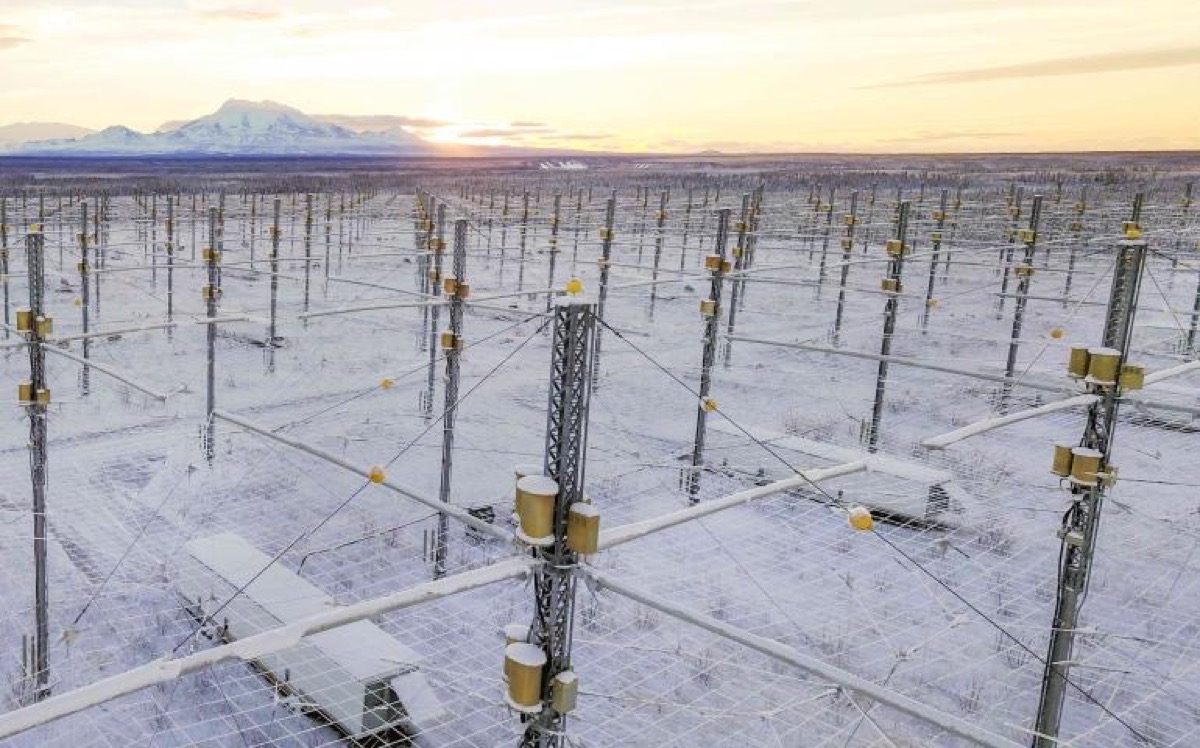
If you Google “HAARP,” the first thing that pops up is usually a conspiracy theory: climate control, induced earthquakes, manipulated minds, “chemtrails,” or dimensional portals. But the official site — haarp.gi.alaska.edu — describes something much more prosaic and verifiable: an upper atmosphere physics laboratory in Gakona, Alaska, where scientists "push" the ionosphere with radio waves to understand how it affects the GPS, communications and “space weather.” This investigative guide compiles what CERN (its own FAQ, the UAF, NASA and independent reviewers) say about the ionosphere, clarifies common confusions—including that of Antarctica—and separates facts, real benefits and myths.
Video: HAARP and conspiracies (scientific presentation, UAF)
Chris Fallen (UAF) publicly dismantles theories about mind control, climate and "chemtrails" during a talk on space physics in Alaska. Source: YouTube — HAARP: New frontiers in space science
What is HAARP (in plain language)
HAARP is the acronym for High-frequency Active Auroral Research Program. It is not a secret weapon or a cloud generator: it is a geophysical observatory whose heart is the Ionospheric Research Instrument (IRI), a phased array of 180 crossed dipole antennas spread over 33 acres (~13 hectares) of Alaskan forest.
The IRI can radiate up to 3.6 megawatts (MW) of radio frequency power in the HF band (2.7 to 10 MHz) into the ionosphere, the ionized layer of the atmosphere that begins about 60–80 km above the ground and extends more than 500 km. According to the official FAQ, the objective is to study physical processes in the thermosphere and ionosphere through active (with transmission) and passive experiments (only observation with radars, magnetometers, digisondes and telescopes).
The analogy the UAF itself uses: HAARP is like putting an immersion heater in the Yukon River. Heats a tiny, temporary volume; the current (in this case, the Sun and solar winds) erases the effect in seconds or minutes.
Where it is (and why it is NOT in Antarctica)
A widespread confusion places HAARP in Antarctica or the "south pole." This is incorrect. The observatory is in Gakona, Alaska, in the interior of the northernmost state of the United States, about 400 km northeast of Anchorage, off the Tok Highway (Steese Highway).
Why Alaska and not Antarctica? Because the program was born to investigate the polar and subauroral ionosphere of the northern hemisphere, where the auroral electrojet (electrical currents at altitude) and phenomena that affect military and civil communications at high latitudes converge. Antarctica has scientific stations (such as the SuperDARN chain radars), but does not host HAARP. The arctic remoteness and desolate landscape fuel the mystery, but geographically it is northern America, not the white continent to the south.
Who controls it today (and who built it)
| Epoque | Control / financing | Notes |
|---|---|---|
| 1990–2014 | US Air Force + US Navy (+ DARPA, UAF) | US Congressional Initiative; ~290 M USD investment; Eastlund patent (1987) fueled military speculation |
| Aug 11, 2015 | Transfer to University of Alaska Fairbanks | CRADA with the USAF; civil equipment, unclassified |
| 2017–today | UAF + NSF (SAGO) | ~$9.3M grant over 5 years for Subauroral Geophysical Observatory |
| Land | Still USAF property (in process of transfer) | NDAA 2017 authorized transfer of ~1,158 acres to UAF; scientific operation is now civil |
Today there are no military personnel assigned to the site: it is managed by the UAF Geophysical Institute. The experiments are proposed by universities (Stanford, MIT, Cornell, UCLA...), government laboratories and international teams; you pay per use (pay-per-use). Campaigns are advertised with public notices, air TFRs, and FCC licenses — it's not a hidden program.
What it investigates and what it is for
The ionosphere is not "weather": it is the border between the dense atmosphere where we breathe and the vacuum of space. It contains free electrons and ions that reflect, refract or absorb radio waves — hence it affects AM/FM, HF communications, radar and GPS/GNSS.
- “Push” the ionosphere: HF pulses create controlled irregularities (artificial periodic inhomogeneities) that radars measure; A 2025 study in Phys.org documented simultaneous APIs in regions D, E, and F using 2014 HAARP data.
- Weak artificial auroras: Faint optical emissions, not spectacular polar auroras; The natural energy of the solar wind is orders of magnitude greater.
- VLF/ELF: HAARP does not transmit these frequencies directly, but can generate them in the ionosphere (~100 km) — relevant for communications with submarines (military historical context).
- Space Weather: Solar storms, coronal mass ejections, and geomagnetic activity that can shut down power grids or degrade satellites — see NOAA Space Weather Impacts.
- Recent experiments: signal bounce with the Moon, observation of STEVE, tests with Jupiter's ionosphere (Johns Hopkins APL), detection of space debris.
In summary: HAARP is used to understand and mitigate communication and navigation failures caused by the Sun and the ionosphere, not to create hurricanes in Miami.
How many HAARP are there? Why "only one" so big?
HAARP is not unique as a concept, but as a power. The ionospheric heaters ("ionospheric heaters") are a family of research facilities active since the 1970s. The main ones in operation or recent ones:
- HAARP (Gakona, Alaska) — 3.6 MW / ~4 GW ERP · the most powerful.
- EISCAT Heating (Ramfjordmoen, Norway) — 1.2 MW / >1 GW ERP · co-located with EISCAT radars.
- SURA (Vasilsursk, Russia) — 750 kW / 190 MW ERP.
- SPEAR (Svalbard, Norway) — 192 kW / 28 MW ERP.
- Arecibo (Puerto Rico) — HF facility associated with the radio telescope (damaged by hurricanes; historical context).
There were others that were smaller or already closed (Platteville, Colorado; HIPAS in Alaska; Islote, Puerto Rico). China has also developed its own ionospheric heaters. "Only one" refers to the fact that no other matches the power and diagnostic package of HAARP, not to the fact that the US has a secret monopoly on the phenomenon.
Can HAARP change or create the climate?
The short answer, repeated in the official FAQ, by Chris Fallen of the UAF and by The Atlantic (2026): no.
The radio waves that HAARP transmits are not absorbed in the troposphere or stratosphere — the layers where clouds, rain, wind and temperature form. Without interaction, there is no weather control. If the Sun's natural ionospheric storms don't turn a rainy Tuesday into a dry one, neither will a transmitter in Alaska.
Numbers that contextualize climate impotence:
- The power flux in the ionosphere by HAARP is < 0.03 W/m² at the most intense point — less than 1/100 of the thermal density of the local ionospheric plasma.
- The Sun delivers ~1.5 kW/m² to the Earth's surface. HAARP is a spark in front of a planetary solar power plant.
- The induced effects last from less than a second to ~10 minutes before dissipating into natural turbulence.
When a hurricane, earthquake, or flood temporally coincides with a HAARP campaign, social media constructs post hoc causality. Seismologists and meteorologists find no physical mechanism: seismic energy leaves the Earth's crust; the climate, of oceans and lower atmosphere. HAARP works dozens of kilometers higher up.
What you CAN do (and what you can't)
| Popular accusation | Verdict | Brief explanation |
|---|---|---|
| Climate/hurricane control | False | Wrong atmospheric layers; negligible energy |
| Induced earthquakes | No evidence | Does not couple energy to tectonic plates |
| Mind control | False | HF waves in ionosphere; on the surface, weaker than a mobile phone (Fallen, UAF) |
| Chemtrails | False | HAARP does not release chemicals; contrails are condensation from jet engines |
| Holes in the ozone layer | False | FAQ: no relevant interaction with stratospheric ozone |
| Weak artificial aurora | True (limited) | Faint optical emissions documented in peer-reviewed literature |
| Useful ionospheric research | True | GPS, radio, space weather defense, plasma physics |
Why HAARP is so controversial
The UAF itself recognizes that HAARP attracts more suspicion than other laboratories. Structural reasons:
- Military origin: decades under USAF/Navy/DARPA, budget in the hundreds of millions, and Bernard Eastlund's patent (1987) that talked about “altering” the ionosphere — patent holders are not operating manuals, but they feed fear.
- Ominous name: “Active Auroral Research” sounds like atmospheric manipulation; The UAF plans to rename the site SAGO precisely to move away from "conspiratorial branding" (The Atlantic).
- Remote location: Alaskan forest, fences, diesel generators — perfect setting for fiction.
- Counterintuitive physics: ionosphere ≠ climate; ERP vs radiated power; intermittent campaigns.
- Algorithmic distrust: Google prioritizes sensational videos; The technical bibliography is in journals such as Journal of Geophysical Research and Radio Science, not on TikTok.
- History with the Ahtna people: land acquisition under threat of eminent domain; The USAF has given back some of the ground — legitimate social criticism, distinct from a “climate weapon.”
Transparency: what is public and what is not
- Not classified: Public EIS (1992–93), FCC licenses, FAA/ADEC permits, transmission notices at haarp.gi.alaska.edu/transmissions.
- Passive data: digisonde and other instruments archive measurements in the Diagnostic Suite.
- Publications: bibliography 1990–2010 on the official site; papers in open access and university repositories.
- What generates suspicion: historical military research not necessarily published; That doesn't prove climate control, but it explains why people distrust the origin.
Real benefits for humanity
- More reliable communications: Understanding HF absorption and dispersion at polar latitudes benefits aviation, emergencies and Arctic operations.
- GPS and GNSS: geomagnetic storms distort signals; modeling the ionosphere improves corrections.
- Space weather defense: NOAA alerts, protection of power grids and satellites — real documented phenomenon (Quebec blackout, 1989).
- Basic plasma physics: Plasma is the most common state of the universe; Controlled experiments complement natural observations.
- Education and dissemination: annual open houses, campaigns announced on networks (@UAFHAARP), open proposals for experiments.
Essential Chronology
- 1987: Eastlund patent on ionospheric modification.
- 1990: start of the HAARP program (US Congress).
- 1993–2007: progressive construction up to 180 antennas and 3.6 MW.
- 2008–2014: more than 20 major campaigns under military management.
- 2015: transfer to UAF.
- 2021–2022: campaigns with NSF/SAGO model; last active IRI operation (Oct 2022, according to FAQ).
- 2025–2026: new papers on ionospheric APIs; media debate (The Atlantic) about SAGO renown.
Conclusion: science in the ionosphere, not magic in the climate
HAARP is real, powerful and one of a kind — but its power is that of a plasma laboratory in the sky, not a weather button. It's in Alaska, not Antarctica; It is operated by a public university, not a secret hurricane command; and shares his method with facilities in Norway and Russia that almost no one mentions in the viral videos.
For the reader with legitimate doubts: distrust towards a project born in the Cold War is understandable; The claim that HAARP “creates haze” or “directs earthquakes” does not stand up to elementary physics or the program's own numbers. If something changes your weather tomorrow, look at the jet stream and ocean first — not Gakona's 180 antennas turned off most of the year.
Most read
What readers are engaging with right now.
- Culture
Goose, the gay app that competes with Grindr, reaches the top 4 of Lifestyle in the App Store

- World
Cubans protest in Miami against Airlines Connections for alleged scam: they demand up to $20,000 in packages to Punta Cana

- World
Trump declares the ceasefire with Iran over, orders new attacks in Hormuz and demands cutting trade with Spain in NATO

- Culture
Harry Potter on HBO: complete guide to the series (not yet released and already renewed for T2), dates, cast and controversies

- Culture
DUK App: Aly Sánchez launches her habits app "one day at a time" with a 63-day program
- Culture
I'm Edgy and Edgy Labs: From Nebraska's Walmart to a beef tallow cream brand that sells across the US.

- Culture
The Evening of the Year VI: all the winners, fights and performances of the Ibai night in Seville

- World
The FBI is investigating the AFA for alleged fraud and money laundering: about $300 million in sponsorships and operations in the US.

- World
El Cangrejo: profile of Raúl Guillermo Rodríguez Castro, Raúl Castro's grandson between GAESA, leaked luxuries and the first interview of 2026