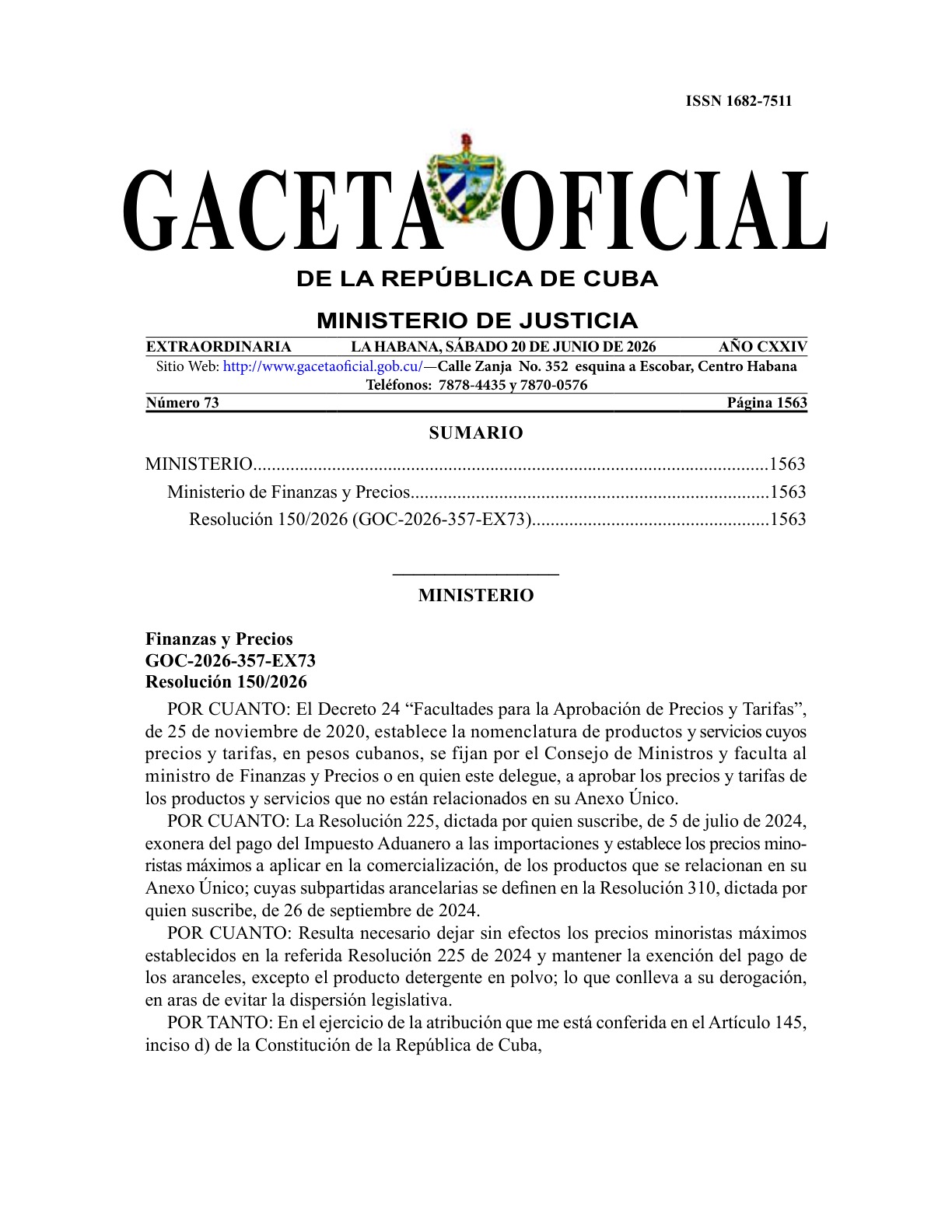
The Ministry of Finance and Prices of Cuba eliminated this Saturday, June 20, the maximum retail prices that since July 2024 had governed various foods imported by passengers - chopped chicken, edible oils (except olive oil), powdered milk, pasta and sausages - according to Resolution 150/2026 published in the Extraordinary Official Gazette No. 73. The measure completely repeals resolutions 225 and 310 of 2024, but maintains the exemption from paying customs duties for those five products. The journalist Mag Jorge Castro was one of the first to spread the change on networks.
The resolution comes barely one day after Miguel Díaz-Canel acknowledged before the Extraordinary Plenary Session of the PCC Central Committee that price caps "failed to contain inflation" and announced that the regime will stop resorting to generalized controls as an anti-inflationary mechanism — a turn that media outlets such as CiberCuba and Havana Times contextualized it as historical self-criticism after years of denying the failure of that policy.
What exactly does Resolution 150/2026 say
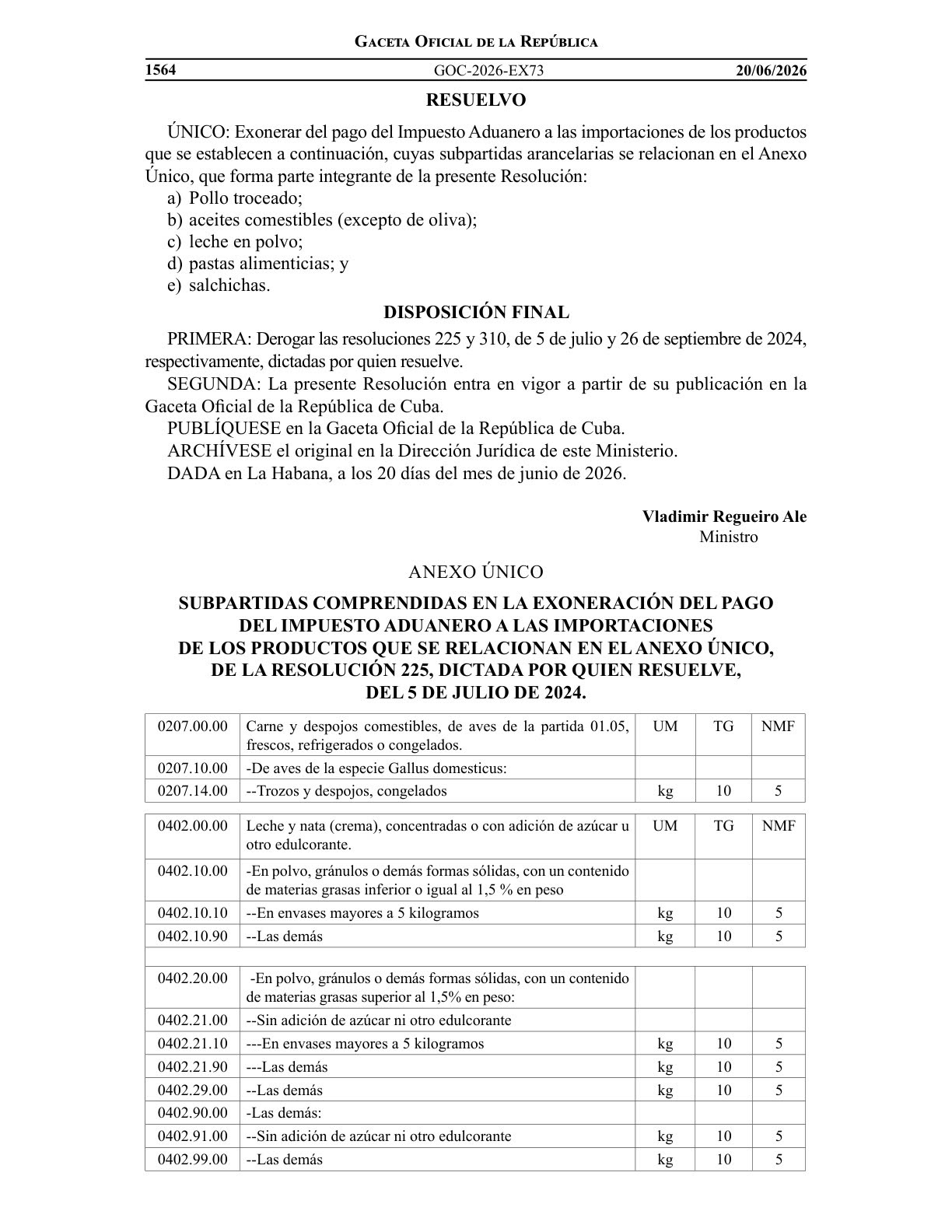
The official text, signed in Havana on June 20 by Minister Vladimir Regueiro Ale, states that "it is necessary to annul the maximum retail prices established in the aforementioned Resolution 225 of 2024 and maintain the exemption from paying tariffs, except for the detergent powder product." In its only operative article, it exempts imports of:
- Cut chicken;
- Edible oils (except olive);
- Milk powder;
- Pasta; and
- Sausages.
The first final provision entirely repeals resolutions 225 (July 5, 2024) and 310 (September 26, 2024), "in order to avoid legislative dispersion." The second provides for entry into force from its publication in the Gazette. The sole annex reproduces the tariff subheadings (0207, 0402, 1507, 1511, 1512, 1601, 1602, 1902) with the weight ceilings and units of measurement applicable to each category.
Context: from the 2024 caps to the recognition of Díaz-Canel
When the government promulgated Resolution 225 in July 2024, the measure sought to contain the increase in the cost of food that came in through luggage and purchases abroad. However, the regime suspended its application before it came into full effect while negotiating with private actors, and economists such as Pedro Monreal then warned that the caps could cause shortages and repressed inflation — exactly what Díaz-Canel admitted on June 18, 2026 before the Central Committee: "they caused the disappearance of products, deviations towards illegality, higher prices, less tax collection and an impossible race between real prices and decisions administrative that were always late.»
«That is why we are not going to continue capping prices in a general way, as the Prime Minister explained.»
Video: Díaz-Canel announces the emergency economic turnaround
Appearance on June 12, 2026 in which Díaz-Canel advanced economic transformations; Days later he recognized the failure of the price caps in the PCC Plenary. Source: Cubavisión Internacional — YouTube
What it means for the street
In practice, Resolution 150/2026 frees private and self-employed sellers from the ceilings set in 2024 on these imported foods, in line with the announced abandonment of generalized controls. This does not guarantee lower prices: in a market marked by shortages, blackouts and inflation that far exceeds wages, the elimination of the cap can translate into higher market prices for those who depend on informal imports or the network of "mules" and passengers.
The tariff exemption—except for detergent—means that whoever imports these products through luggage will continue without paying the Customs Tax, but now with no official limit on the resale price. For powdered detergent, the resolution represents a toughening: it loses the exemption it had under Resolution 225. The document does not establish new direct subsidy mechanisms or transition calendar; It is limited to repealing the previous framework.
Fit with the 176 measures and the end of the cap policy
Resolution 150/2026 fits into the broader shift that the regime articulated this week: on June 18, the National Assembly ratified 176 economic transformations—private banking, progressive end of universal subsidies, opening to foreign capital—and Díaz-Canel recognized that administrative price fixing had failed. Repealing the caps on imported food is one of the first concrete pieces of legislation in that speech, although the government has not yet published a detailed schedule of how it will replace generalized subsidies with targeted aid.
For the independent press and the diaspora, the measure confirms what analysts had been pointing out since 2024: price controls in Cuba did not contain inflation but rather pushed products towards the black market. Resolution 150/2026 does not resolve the structural shortage - dependence on imports, energy crisis, GDP contraction - but it does withdraw an instrument that the president himself has just described as counterproductive.
Most read
What readers are engaging with right now.
- Culture
Goose, the gay app that competes with Grindr, reaches the top 4 of Lifestyle in the App Store

- World
Cubans protest in Miami against Airlines Connections for alleged scam: they demand up to $20,000 in packages to Punta Cana

- World
Trump declares the ceasefire with Iran over, orders new attacks in Hormuz and demands cutting trade with Spain in NATO
- Culture
Harry Potter on HBO: complete guide to the series (not yet released and already renewed for T2), dates, cast and controversies

- Culture
DUK App: Aly Sánchez launches her habits app "one day at a time" with a 63-day program

- Culture
I'm Edgy and Edgy Labs: From Nebraska's Walmart to a beef tallow cream brand that sells across the US.
- Culture
The Evening of the Year VI: all the winners, fights and performances of the Ibai night in Seville

- World
The FBI is investigating the AFA for alleged fraud and money laundering: about $300 million in sponsorships and operations in the US.
- World
El Cangrejo: profile of Raúl Guillermo Rodríguez Castro, Raúl Castro's grandson between GAESA, leaked luxuries and the first interview of 2026