Cuba closed this week a chapter of more than three decades of Spanish hotel dominance on the island. On July 24, 2026, Meliá Hotels International completed its total withdrawal from the country—the last link in a rout that had already dragged down Iberostar, Barceló, Blue Diamond, Archipelago International and other foreign chains.
For the first time in decades, no large international brand manages hotels on the island, according to EFE and specialized media. The buildings do not disappear: they remain in the hands of the State. What is lost is the brand, the global marketing and the management standards that attracted millions of tourists from Spain, Canada and Mexico.
Video: Meliá leaves Cuba due to US sanctions
Associated Press coverage of Meliá's closure of operations in Cuba. Source: Associated Press — YouTube
The week that changed Cuban tourism
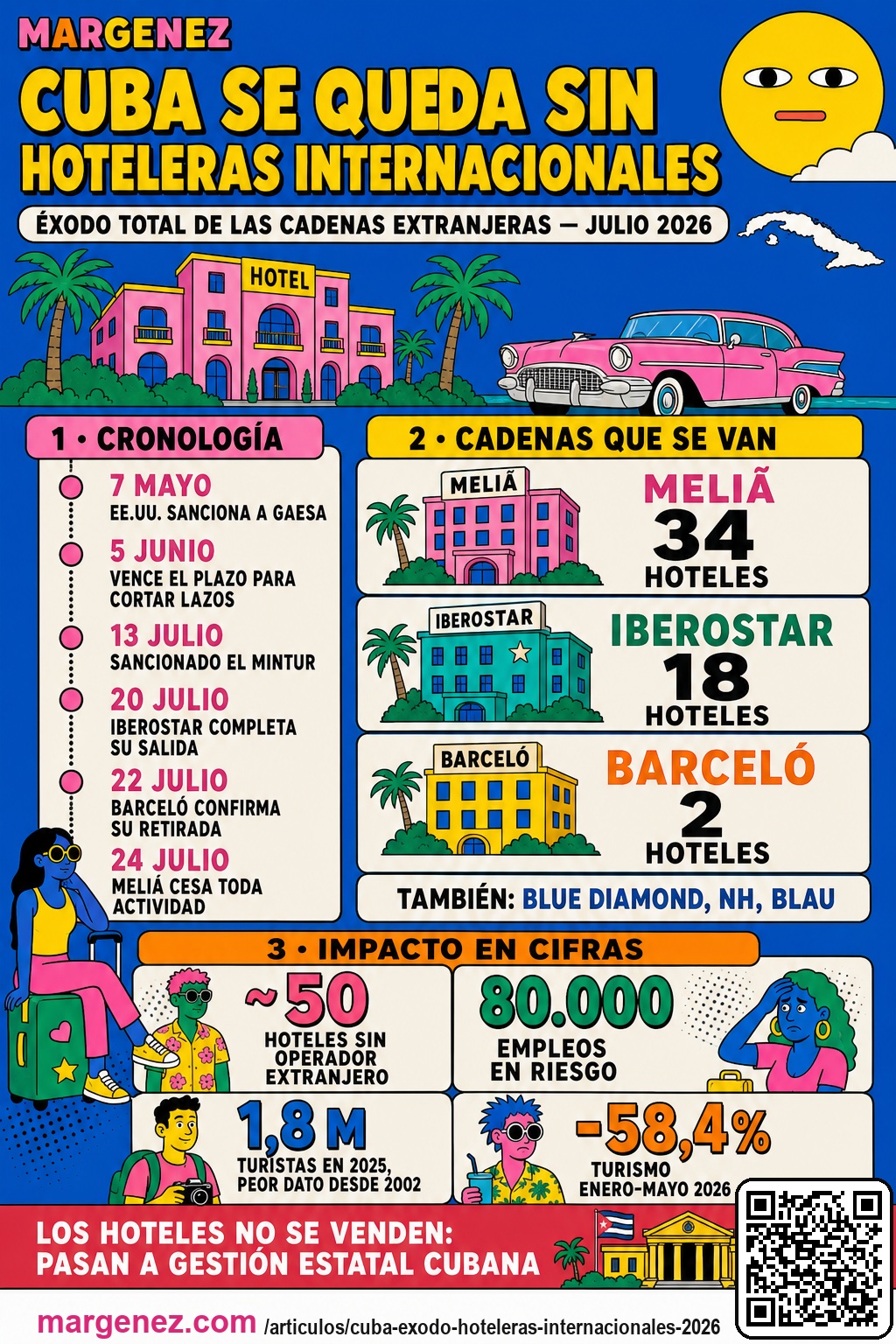
The exodus was not a single announcement, but a chain escalation between June and July. On May 1, 2026, Donald Trump signed Executive Order 14404. On May 7, the Treasury designated GAESA, the military conglomerate that controls a good part of tourism through Gaviota. On June 5 the deadline for foreign companies to cut ties with GAESA expired under threat of secondary sanctions.
That month, Iberostar left 12 Gaviota hotels; Blue Diamond ceased operations; and Meliá abandoned 15 establishments linked to the military group. The final blow came on July 13, when OFAC designated the Ministry of Tourism (MINTUR) as a sanctioned entity. Meliá and Iberostar had tried to stay in hotels in Gran Caribe and Cubanacán, but MINTUR supervises both state chains. Once designated, there was no legal counterpart for foreign operators, according to Travelers Today.
Iberostar completed its departure on July 20; Barceló confirmed his on 22; and Meliá closed the cycle on 24, according to Euronews and El País.
Who left and how many hotels they left
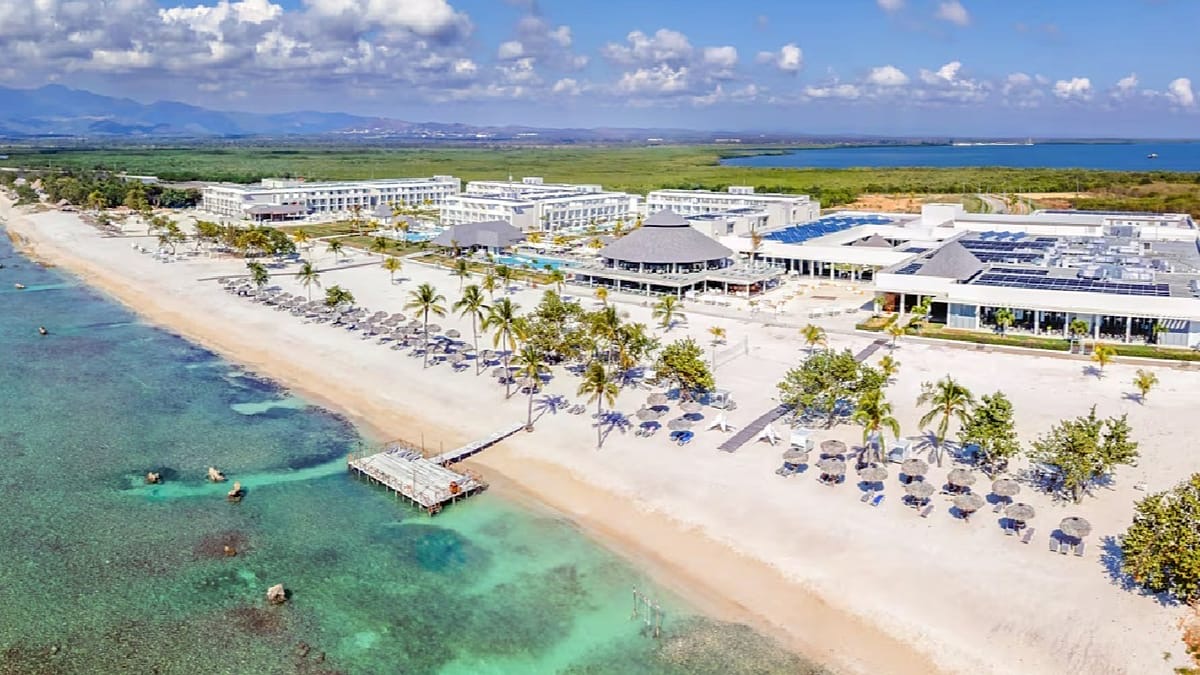
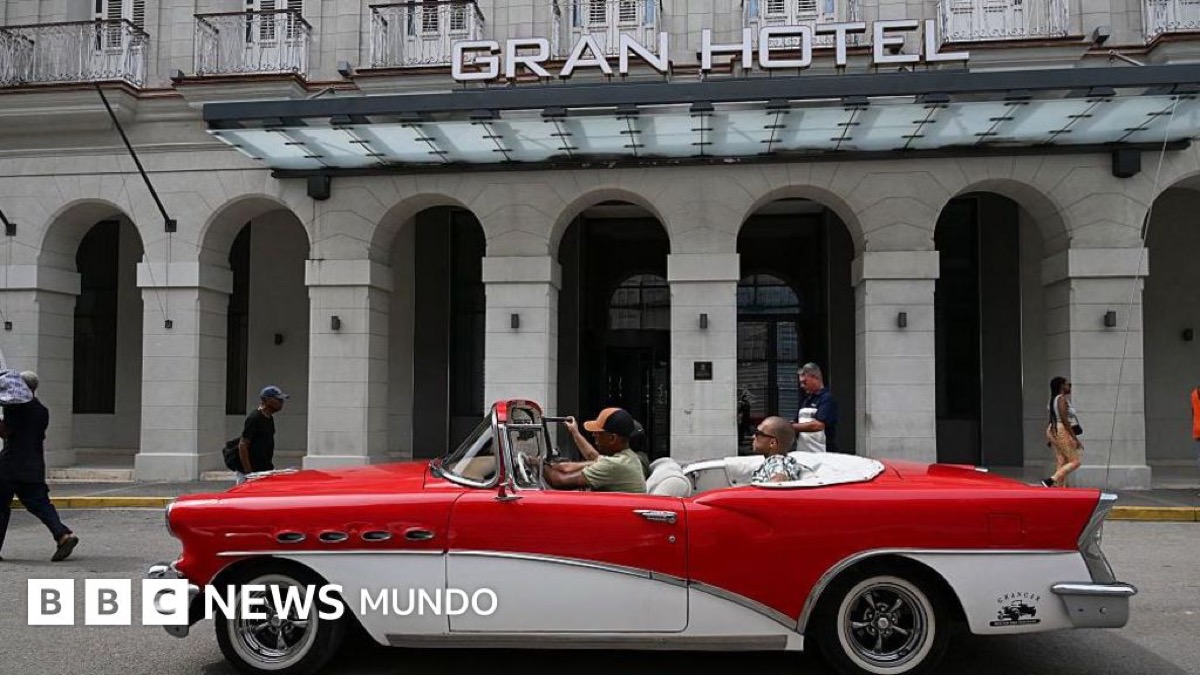
Meliá operated 34 hotels and more than 14,000 rooms. It informed the CNMV that its Portuguese subsidiary Ilha Bela Gestão e Turismo would cease "all of its hotel management and marketing services" on July 24. Among the emblematic ones: Gran Hotel Bristol Habana Vieja, Paradisus Varadero, Sol Varadero Beach, Meliá Habana and Meliá Cohiba.
Iberostar left its 18 establishments, including the Grand Packard, the Iberostar Selection La Habana (Tower K, the tallest hotel building in Cuba) and the Iberostar Parque Central. The chain confirmed that "it no longer operates or markets any hotel in Cuba," according to Expansión.
Barceló had only two hotels in Varadero (Occidental Arenas Blancas and Barceló Solymar), with a contract valid until 2027, but terminated the agreement early. They were joined by Blue Diamond (Royalton, Memories, Starfish brands), Archipelago International (Aston, including the Grand Aston on the Malecón), Minor Hotels (NH Capri and NH Collection Victoria), Blau Hotels, ATG Hotels and others.
Altogether, there are around 50 state-owned hotels—mostly Gaviota—that were left without a foreign operator, according to OnCubaNews. The BBC estimates that up to 80,000 jobs could be at risk.
Who's still left?
Almost no one. As of July 24, EFE points out that there is no major international brand left managing the Cuban hotel plant. The only partial exception reported in June was MGM Muthu Hotels (India): the Gran Muthu Almirante Beach in Holguín, linked to Cubanacán and not to GAESA, was still active with good Canadian occupancy. The Gran Muthu La Habana (Gaviota) was operating half-heartedly, according to 14ymedio.
Hotels are not selling: who manages them now?
In Cuba the model is not one of sale of real estate to foreigners. The hotels are property of the State (Gaviota, Gran Caribe, Cubanacán). The international chains had management, branding and marketing contracts. When Meliá or Iberostar leave, they don't take the building with them: they stop managing it and using its name.
There are three immediate scenarios, according to BBC Mundo and analysts cited by the press: direct state management by Gaviota, Gran Caribe or Cubanacán; temporary closure due to energy savings and lack of tourists; or the government's commitment to «new actors»—Cubans abroad and entities without ties to the United States—, announced by Miguel Díaz-Canel in June (OnCubaNews).
The regime published a list of about 40 "operational" hotels for the summer in Havana and Varadero - many still with Meliá or Iberostar names - but platforms such as Booking and TUI had already removed a large part of the Cuban inventory.
Which investors can enter now?
The scenario is more speech than reality in the short term. The Cuban State will assume management by default. Díaz-Canel talked about attracting Cubans abroad, but the sanctions on GAESA and MINTUR, tourism in free fall (-58.4% Jan-May 2026), the suspension of Sunwing packages and the cancellation of Air Canada routes block any serious investor.
Media such as Reportur mention the possible return of Royalton/Marriott, but it is an unconfirmed rumor. Analysts speculate with American chains (Marriott, Hilton, Hyatt) only if the bilateral relationship radically changes; Marriott was already in Havana with the Four Points Sheraton (2016–2020) and lost the license.
Cuba against Meliá and Iberostar: the legal battle
Parallel to the exodus, Havana threatens lawsuits against Meliá and Iberostar for unilateral abandonment of contracts. According to El País, the Cuban government maintains that US sanctions do not constitute force majorto terminate agreements and could demand compensation via arbitration. The hotel companies, on the other hand, allege economic infeasibility: without electricity, without food, without flights and with occupancy below 20%.
Tourism in numbers: a sector in a coma
Cuba received 4.2–4.7 million tourists in 2018–2019. In 2025 it closed with 1.8 million, the worst figure since 2002. Between January and May 2026, 359,491 visitors arrived (-58.4% vs 2025); in May alone, 30,883. The estimated losses of Spanish hotel companies are around 80–100 million euros, according to the economic press.
What does it mean for the traveler?
Active reservations at Meliá, Iberostar or Barceló may have been canceled or transferred without clear notification. Hotels can remain physically open under state management, but without international branding or global reservation channels. The tourist experience deteriorates with blackouts, water cuts and reduced staff. Those who travel to Cuba may lose the option of an ESTA visa for the United States, according to EFE.
In summary
Cuba does not lose hotels: it loses the ecosystem that made them function as an international destination. After more than 30 years of Spanish presence, the island is left with state buildings, tourism in free fall and no new investors in sight. The regime speaks of "new actors", but the sanctions, the energy crisis and the collapse of flights turn this speech into a bet for survival, not a recovery plan.
Breaking news (July 25, 2026): Meliá completed its departure from Cuba on July 24. Iberostar and Barceló no longer operate on the island. News based on Associated Press, EFE, El País and Euronews.
Most read
What readers are engaging with right now.
- World
Cubans protest in Miami against Airlines Connections for alleged scam: they demand up to $20,000 in packages to Punta Cana
- Culture
Goose, the gay app that competes with Grindr, reaches the top 4 of Lifestyle in the App Store

- Culture
Harry Potter on HBO: complete guide to the series (not yet released and already renewed for T2), dates, cast and controversies

- World
Trump declares the ceasefire with Iran over, orders new attacks in Hormuz and demands cutting trade with Spain in NATO
- Culture
DUK App: Aly Sánchez launches her habits app "one day at a time" with a 63-day program
- Culture
I'm Edgy and Edgy Labs: From Nebraska's Walmart to a beef tallow cream brand that sells across the US.

- World
El Cangrejo: profile of Raúl Guillermo Rodríguez Castro, Raúl Castro's grandson between GAESA, leaked luxuries and the first interview of 2026
- World
The FBI is investigating the AFA for alleged fraud and money laundering: about $300 million in sponsorships and operations in the US.
- World
Cuban regime terrorist Ramiro Valdés Menéndez dies