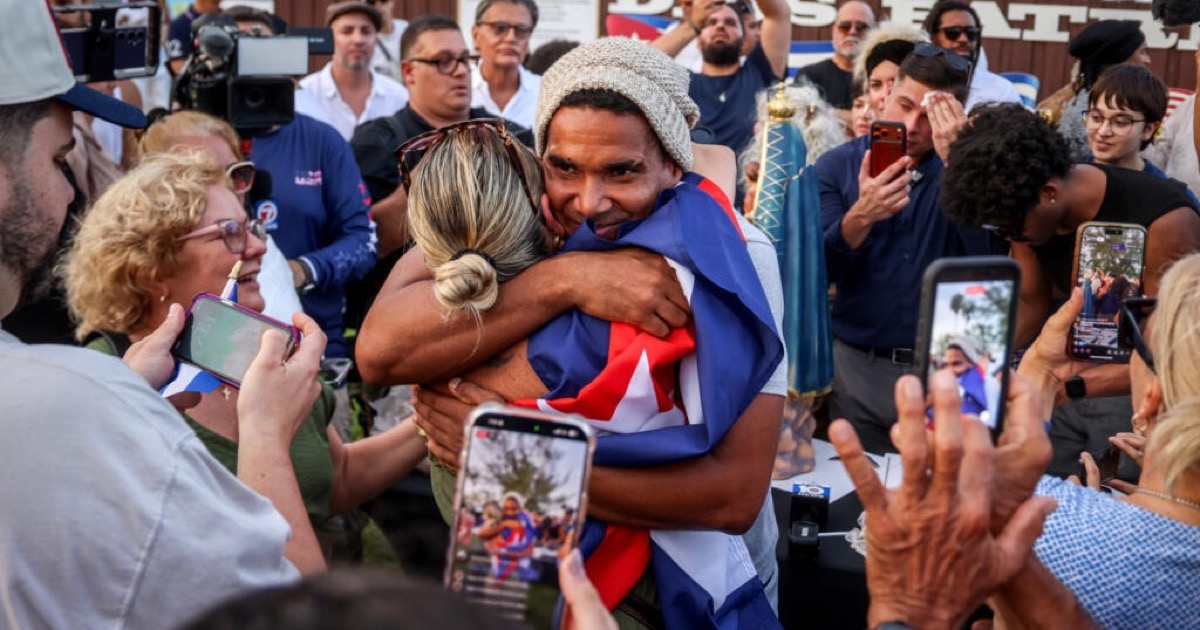
Luis Manuel Otero Alcántara landed in Miami on Saturday, July 18, 2026 with the Cuban flag on his shoulder and, in a matter of hours, he offered at the Ermita de la Caridad a detailed account of his time in prison, the situation in Cuba and what will come with Maykel Osorbo. For a part of the exile, that is resistance and lucidity. For another – increasingly vocal on social networks – it is the missing piece in an uncomfortable puzzle: a man who supposedly hates the regime, left Guanajay with an impeccable face and clothes, spoke as if he had never lost the thread of the world, praised conditions that other political prisoners describe as subhuman and, with this, questioned not only his own narrative, but that of all the "liberators" that Washington and Havana have been escorting to Miami, starting with José Daniel Ferrer.
This text is an investigative analysis. It collects verifiable facts with primary and secondary sources, contrasts testimonies and points out hypotheses—including that of possible infiltrators—without affirming what is not proven. He does not intend to close the Otero case; aims to organize the debate.
Video: Otero Alcántara's arrival in Miami
Coverage of the arrival at Miami airport after liberation and negotiated exile. Source: YouTube — CBS Miami
What is documented
The factual sequence is clear. Otero served five years in prison after being arrested on July 11, 2021 when he tried to join the 11J protests. He was convicted of public disorder, contempt and insult to national symbols. On July 7, 2026, two days before the end of his sentence, he was taken from Guanajay and remained in the custody of State Security in a non-public location for more than a week, according to Associated Press and France 24.
On Friday the 17th he obtained authorization to travel; On Saturday the 18th he arrived in Miami on a commercial flight. The United States granted him a humanitarian immigration permit (parole), according to Infobae/EFE. His relatives described exile as "the only way" to regain freedom "at this moment." Amnesty International considers him a prisoner of conscience; Havana denies that status.
Statements that divide
At the Ermita and in subsequent interviews, Otero Alcántara said several things that many activists celebrated and that another part of the diaspora received with friction:
- That in prison they allowed him to continue painting and that, if he had not done so, he "would have died" — phrase collected by Cuba in Miami.
- That he removed from Cuba more than 4,000 works made during the confinement and that some 200 were retained due to their content.
- That the Cuban government would send the rest of the retained pieces — a promise that, as of the date of this analysis, has not been publicly fulfilled.
- That his confinement was not a "happy resort", but that the prison treatment was in a certain way tolerant of his artistic activity.
- That Maykel Osorbo could be in Miami "soon", "in less than a month", according to contacts at the US embassy - without being able to guarantee it, according to Translating Cuba / 14ymedio.
He also claimed to feel "mentally healthier" and declared: "A minute I lose is one more minute of dictatorship", in line with his role as an artist-activist, according to Cubanet.
«They knew that if I didn't paint I would die.»
— Luis Manuel Otero Alcántara, cited by Cuba in Miami
Do you defend the people or throw them "down the road"? The controversy of the bomb and "intelligence"
In the extensive questionnaire of the Hermitage - broadcast live by Telemundo 51 and collected by Martí Noticias, Cubanet and other media—, Otero addressed the rumor of a US military intervention. What is verifiable is this: he rejected that change depends only on external factors.
«Right now there is talk about Donald Trump, that the Americans are going to invade. But really what is happening right now is the product of the work of all of us."
— Luis Manuel Otero Alcántara, cited by Cubanet and Cuba in Miami
So far, a coherent message with those who ask the people for civic responsibility. But on the same afternoon, when journalists and assistants asked him why Washington would not attack rural areas of Cuba despite the tensions with Trump, a passage emerged that was not included in all the editorial summaries but that circulates in clips from the diaspora and in viral comments that MARGENEZ has tracked: according to these versions, Otero explained that the Americans are not going to "spend" bombs—each one costs around a million dollars, he said—in the Cuban countryside because they are "smarter" than wasting that money on a town that, in their formulation, is not "worth" that figure.
Methodological warning: there is no official word-for-word transcription of that fragment in agencies such as AFP or EFE; It comes from the audio/video of the event and the immediate reaction on networks. Even so, the meaning of the comment—if confirmed—collides head-on with years of speech in which Otero presented himself as the voice of ordinary Cubans against the regime.
For many readers inside and outside the island, the reading is brutal: who asked to "arm the Cuban people with civic thought" (Martí News) now appears to reduce its audience to an accounting equation—less than the price of a projectile—and place Americans on a higher intellectual echelon. It is not a criticism of war; It is, according to the harshest interpretation, contempt disguised as realism.
The contrast hurts more if you look at the context:
- In prison, his entourage reported that he was dying of hunger, without an ophthalmologist and with an affected eye — a campaign that mobilized Amnesty and Rubio.
- When leaving, he talks about good treatment, 4,000 exported paintings and impeccable appearance.
- In Miami, the speech oscillates between "we are all broken" and phrases that, for critics, throw the people "like garbage" while he lands with parole, international coverage and promises of exposure in exile.
From the island, the message that comes is not of liberation but of hierarchy: the VIP prisoner explains why no one will come to rescue them with bombs, while thousands remain in Guanajay without parole or an airport. From Miami, part of the exile who cheered him at the Hermitage begins to wonder if he did not support another "liberator" who jumped on the train—visibility, funds, contacts in Washington—knowing that there they will obtain prizes, asylum and microphones.
The suspicion is not new. The regime accused him for years of being a mercenary and of receiving payments from the National Democratic Institute (NED); he denied it. What is objective: he left a maximum security prison with thousands of works of art—something unprecedented for an anonymous 9/11 protester—and with a story of tolerant treatment. For those who look at him without a flag, the figure looks less like a popular martyr and more like a cultural operator with privileged access: painter, performer, symbolic traffic of pieces and now narrator of why the people are "not worth" a bomb.
Does he deserve the freedom that was offered to him? Legally and humanely, yes: five years for protesting is unfair. But the moral question that the Cuban street asks is another: why does he leave with 4,000 paintings and Osorbo is still in Guanajay? And why do those who for years asked for solidarity with the "suffering people" end up, at the first microphone in Miami, comparing that people with the price of weapons?
Ferrer, Otero and other negotiated releases have no obligation to stay in Cuba — the regime imposes exile on them. But when the public narrative denigrates the collective intelligence of those who cannot yet leave, the political cost is paid by all dissidents: within, because they lose credibility; out, because it confirms the caricature of "butler clowns" that the Havana government has been selling on television for decades.
The image that doesn't fit: body, clothes and "keeping up to date" from the cell
Beyond the words, what generated the most comments in the diaspora was not the fragmented Virgin but how Otero Alcántara looked when leaving the airport and arriving at the Hermitage. Photographs by El País and agencies like AFP show him with a clean long-sleeved shirt, a cap wool, cared for skin and serene demeanor — nothing that reminds us, at first glance, of the average Cuban who today on the island ages with blackouts, lines and survival diets, nor of the common prisoner who leaves Guanajay with lost kilos, anemia and skin diseases.
That doesn't prove anything on its own: a prisoner with an international profile may receive medical care, clothing brought by family members, or prison privileges invisible to the rest. But in the popular imagination of exile—where many have relatives who came out of Cuban prisons emaciated—the image is shocking. "He doesn't look like someone who has spent five years in maximum security of the regime he claims to hate," summarizes the sentiment of dozens of comments in WhatsApp and X groups that MARGENEZ has tracked without being able to verify identities.
The second obstacle is information. On July 9, when his whereabouts were still officially unknown, Otero managed to call activist Anamely Ramos from a State Security phone, with the call on loudspeaker, as she reported and collected 14ymedio and Martí Noticias. Days later, in Miami, he spoke with ease about the fifth anniversary of 9/11, the parole process, Osorbo, the "reconstruction" of Cuba and US policy — as if the confinement had been a tactical pause, not a five-year blur.
The 11J prisoners in Guanajay, on the other hand, denounce isolation, confiscation of phones and reprisals when they dare to describe conditions. If Otero was cut off from the world—as Cubalex and the UN demanded—how do you explain the almost journalistic dominance of the context when he reappeared? If you had privileged access to information and communication, how is that different from the treatment the regime denies to others?
«Today he gets to live, resume his creative projects and continue working for the freedom of Cuba.»
— Account managed by relatives of Otero, cited by 14ymedio, when announcing his departure
The official account of his relatives also admits that in Guanajay "they deprived him of his freedom, prevented him from fully developing his work and took him away from his family" - but does not mention hunger, beatings or plagues. It is a very different vocabulary from that of the anonymous protesters of Detachment 10. That linguistic asymmetry—“artistic incommunication” versus “concentration camp”—is what fuels the phrase that circulates in Miami: “he seems more like a VIP release than a political prisoner”.
What happened to the bad eye and the hunger strikes?
For years, the international campaign for Otero Alcántara revolved around his fragile health. It was not an isolated episode:
- 2022 — vision: After a hunger strike, he suffered partial paralysis and was left with a “constant black spot” in his visual field, according to his partner Claudia Genlui in Radio Televisión Martí. He requested eye care that, according to activists, the prison did not provide (CiberCuba).
- 2024 — epidemics: Contracted chikungunya in Guanajay during a prison outbreak; Previously, he had reported scabies misdiagnosed as "fungi", according to Martí Noticias.
- March 2026 — strike: He began a fast and then a hunger strike after death threats and the fear that his sentence would be extended beyond July 9, according to Anamely Ramos and 14ymedio.
Organizations such as Amnesty International, HRW and PEN International used these alerts to demand his release. Washington and exile amplified the story of the seriously ill prisoner without medical care. It was—and remains—a legitimate argument against the regime.
What was he like when he left? At the Ermita, Otero said he felt "mentally healthier" but admitted not knowing the physical impact that the confinement left behind, according to Cubanet. He did not publicly offer a medical report on the eye. He did not appear with a patch, bandage or visible reference to the black mark that worried his surroundings for years. The arrival photos - AFP, El País, CBS - show a man who walks upright, gestures naturally and does not exhibit the deterioration that many expected after five years of strikes and a sentence in maximum security.
There are three possible readings—none excludes the others:
- Real recovery. The last days in State Security custody (7–18 July) may have included medical attention before the flight to Miami — a privilege that other prisoners never receive.
- Tactical exaggeration. In political prisoner campaigns, health becomes a currency of international pressure; When it is negotiated, the body "composes itself" and the story of gravity is left without public closure.
- Narrative incoherence. If the regime had him dying and without an ophthalmologist in 2022, how does he come out in 2026 talking about painting 4,000 paintings and feeling mentally well — without mentioning whether or not he sees normally?
For the Cuban who followed the cause on networks, this is not a minor detail: was it a real illness exploited and then abandoned in the discourse, or a manufactured crisis to push exile? Otero did not clarify it. And that omission—along with his good physical appearance—fuels the suspicion of “prepared theater”: first, the sick prisoner who moves the world; then the presentable ex-prisoner who gives thanks and paints pictures. Without proof of deception, but with an uncomfortable void that the artist himself has not closed.
The clash with Guanajay
Here is the core of popular disbelief. Otero and Osorbo were in the same Guanajay maximum security prison — Osorbo was transferred there on July 11, 2026, just as the fifth anniversary of 9/11 was marking, according to CiberCuba. But the testimonies of other political prisoners from the same prison paint a scenario radically different from the story of "good treatment":
- Extreme overcrowding: dozens of inmates in spaces of about 12x8 meters, according to complaints collected by Martí Noticias.
- Pests of bedbugs, cockroaches and mice in detachment 10, according to Cubanet.
- Insufficient and unhealthy food: minimal rice rations, pasta "with worms", absence of proteins — no special diets except what families manage to introduce.
- Structural malnutrition: Prisoners Defenders estimated that Cuban prisoners receive only 10–14% of the necessary kilocalories, according to a report cited by 14ymedio.
How does that fit with a high-profile political prisoner who leaves with thousands of paintings, some approved for export, and a speech that does not describe torture but a kind of "tutored creative resistance"? There are at least three possible readings — and they are not exclusive:
- Different treatment based on notoriety. The regime sometimes modulates repression according to the international political cost. An artist with awards, AFP coverage and pressure from Rubio is not an anonymous 9/11 protester.
- Strategic story. Otero needs to explain how he survived five years without completely breaking; Art as a survival narrative legitimizes its figure and avoids details that complicate future negotiations.
- Operation exit. Release from prison in exchange for exile—a repeated pattern—empties the dissident voices in the territory and relocates them to a Miami media ecosystem where the impact on the Cuban street is indirect.
The boss Ferrer and the "liberators" of Miami
The question that many Cubans ask on networks—crudely—is simple: how does this benefit those who remain without electricity in Havana or without insulin in Santiago? The closest precedent is José Daniel Ferrer, leader of the UNPACU, who arrived in Miami in October 2025 after another exile negotiated between Washington and Havana, according to El País. Ferrer had refused to leave Cuba for years; He gave in, he wrote from prison, in the face of pressure and mistreatment — and landed in Miami received by congressmen, without a press conference in the terminal, and promising to return "as soon as possible."
El País explicitly placed Otero's departure in that same pattern: high-profile prisoners released only if they accept the exile. Ferrer condemned at the time that "the regime places as a condition that a Cuban can only obtain freedom if he leaves his country." Months later, Otero repeats the choreography — with better lighting and more cameras.
Ferrer promised to continue fighting from exile and warned about the fragmentation of the opposition. In an interview with Telemundo 51 he said that he lacks "cohesion, coordination, discipline" and accused people who attack him on state television of being MININT infiltrators. Brutal irony: Otero's statements—grateful tone, tolerant prison story, promises about Osorbo—now make part of the audience look at both with the same magnifying glass: are they leaders that the regime expels because they get in the way, or figures that the regime lets out because it is convenient?
Nothing indicates that Otero or Ferrer are infiltrators. There is no public proof of this. What the Otero case does do is spread suspicion towards the entire ecosystem of "liberators" installed in Miami: artists, rappers, leaders of UNPACU and MSI who come out talking, well dressed, well informed, while in Guanajay there are still young people from 11J with bedbugs on their bodies and without a lawyer. Ferrer in Miami did not stop the blackouts; Otero in Miami did not release Osorbo — who is still serving nine years and was transferred to Guanajay under opaque circumstances.
If the public message of the released VIP is "in prison they treated me well and I painted 4,000 paintings", the message that the Cuban receives on the island is different: the famous dissidents negotiate solutions; Anonymous dissent rots in Detachment 10.
Why do some suspect "infiltration"?
The insider hypothesis—very present in forums and WhatsApp groups—does not come from nowhere. The Cuban government has historically documented operations to penetrate dissidents (case G2, "operation Mongo", etc.). Ferrer himself has said he has identified more than 200 agents throughout his career. When an opponent leaves prison speaking in a grateful tone, arrives directly at the Hermitage, receives coverage from Rubio and announces that another famous prisoner will come "soon", part of the audience reads a choreography: the system takes out the pieces that get in the way on the street and turns them into narrative assets outside the island.
That reading is speculative. It is also understandable if contrasted with:
- J11 prisoners who serve very long sentences without international visibility.
- Osorbo, co-author of “Patria y Vida”, still locked up while his partner in the cause is already in Miami.
- The absence of structural changes in Cuba despite each symbolic "victory" of the exile.
Suspicion does not require Otero to be an undercover agent; It is enough that the design of the system benefits the regime when the loudest voices emigrate and the people remain without tools of organized pressure.
What each actor earns
| Actor | Possible profit | Limit |
|---|---|---|
| Cuban regime | Reduces internal pressure; eliminates symbol on the street; shows "openness" without reforms | Loses narrative of total control; validates that the exit passes through Washington |
| USA. USA | Visible humanitarian gesture; reinforces Rubio's speech about political prisoners | Economy or repression on the island does not change with a parole |
| Otero / dissident in Miami | Personal freedom; artistic platform; possible exhibition of the 4,000 works | Physical distance from Cuba; risk of being read as a “comfortable exile” |
| People in Cuba | Symbol that international pressure sometimes works | No light, no health, no freedom — and with thousands still in prison |
Maykel Osorbo: the pending test
Otero's most specific statement in the Ermita was about Osorbo: he could arrive in the United States in less than a month. If that happens, it will reinforce the thesis that Washington and Havana are negotiating exits in batches. If it does not happen—as already happened when Osorbo was offered exile in 2026 and the regime did not comply, according to activists cited by CiberCuba—the credibility of the announcement suffers and suspicion of theater increases.
Osorbo is not a painter of paintings in a cell: he is the face of a song that mobilized millions. His departure would have another symbolic weight. His stay in Guanajay, while Otero speaks in Miami, is the starkest reminder that not all political prisoners receive the same treatment or the same release.
Conclusion: facts, questions and what we don't know
Facts: Otero served his sentence, was released in exchange for exile, arrived in Miami, spoke at the Hermitage, claimed to have painted thousands of works and hopes that Osorbo will follow him. The regime continues to imprison, extinguish and export high-profile dissidents as the country collapses.
Open questions: Why does the same prison that others describe as subhuman appear in Otero's story as an art workshop with enough food? How do you explain his physical appearance and his information dominance after years of supposed lack of communication? Will the promise to send the withheld works be fulfilled or is it part of an opaque negotiation? Does each arrival of a "liberator" to Miami—Ferrer yesterday, Otero today, Osorbo tomorrow?—better organize the opposition or discredit it in the eyes of the people who remain without power?
What we do not know: if there are non-public agreements between Havana, Washington and the released prisoners themselves; if Otero or future arrivals maintain contacts with State Security; whether the suspicion of infiltration applies to this specific case. Stating it without evidence would be irresponsible. Ignoring the pattern would be naive.
For the Cuban who has no voice in Miami or paintings to export, the "reconstruction of the Virgin" in the Hermitage can inspire hope or seem like a parallel world. The two reactions coexist in the diaspora — and both deserve to be understood with data, not just with flags.
Most read
What readers are engaging with right now.
- Culture
Goose, the gay app that competes with Grindr, reaches the top 4 of Lifestyle in the App Store

- World
Cubans protest in Miami against Airlines Connections for alleged scam: they demand up to $20,000 in packages to Punta Cana
- Culture
Harry Potter on HBO: complete guide to the series (not yet released and already renewed for T2), dates, cast and controversies

- World
Trump declares the ceasefire with Iran over, orders new attacks in Hormuz and demands cutting trade with Spain in NATO
- Culture
DUK App: Aly Sánchez launches her habits app "one day at a time" with a 63-day program

- Culture
I'm Edgy and Edgy Labs: From Nebraska's Walmart to a beef tallow cream brand that sells across the US.

- World
El Cangrejo: profile of Raúl Guillermo Rodríguez Castro, Raúl Castro's grandson between GAESA, leaked luxuries and the first interview of 2026
- World
Cuban regime terrorist Ramiro Valdés Menéndez dies
- World
Supreme Court, June 23, 2026: analysis of Tuesday's 5 rulings (and what each one implies)