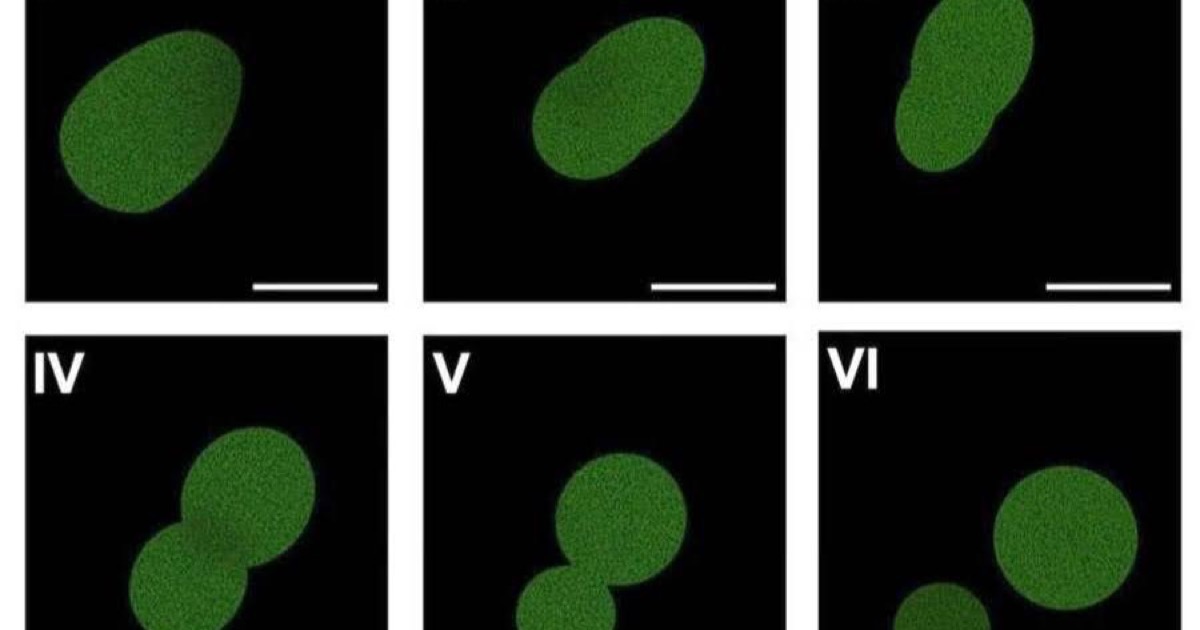
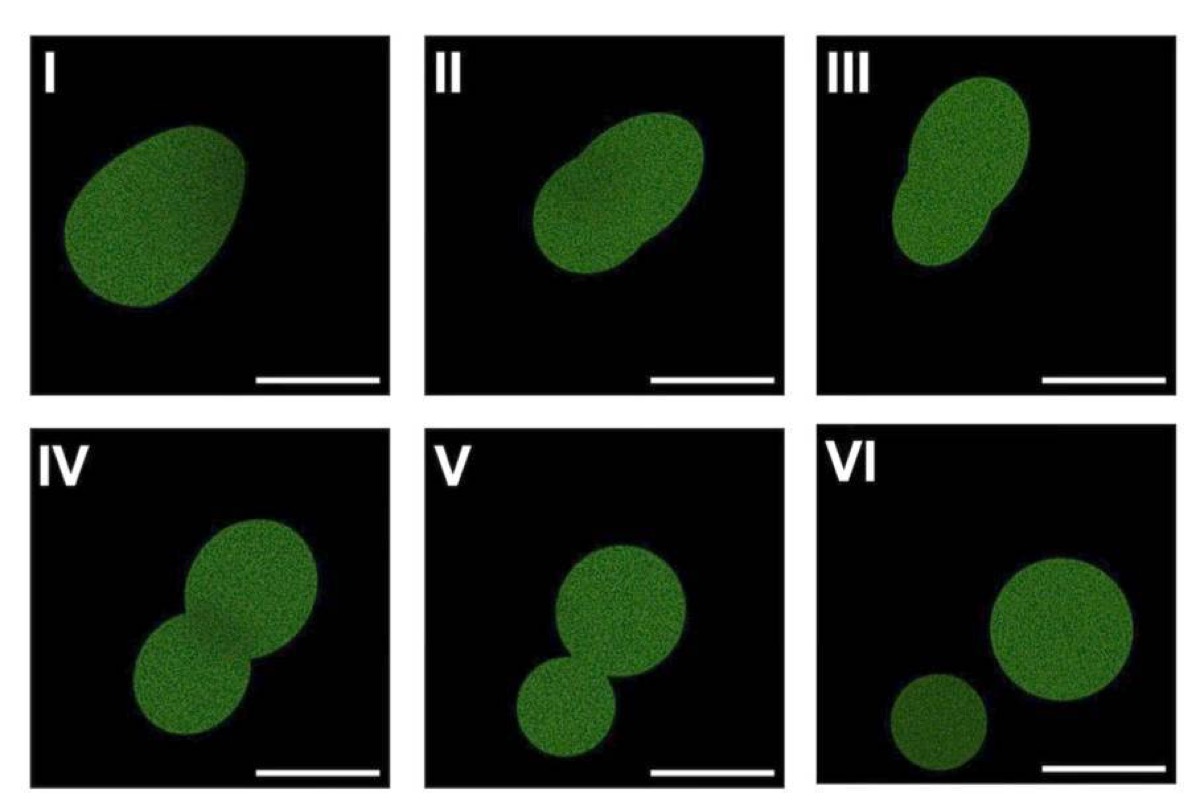
For decades, synthetic biology advanced by cutting up live bacteria or assembling loose reactions in test tubes. On July 1, 2026, Professor Kate Adamala and her team at the University of Minnesota gave a different step: they presented SpudCell, an artificial cell built from scratch with purified chemical components - not with a cut-up living organism - capable of completing an entire cell cycle: feeding, growing, copying its genome, dividing and undergoing selection and competition between generations. The work is at bioRxiv and the foundation Biotic publishes the informative explanation at biotic.org/research/spudcell.
Video: Kate Adamala explains minimal synthetic cells (TEDxBeaconStreet, 2017)
Before SpudCell, Adamala already defended in this talk the idea of assembling biology with defined parts in the laboratory — the same "bottom-up" approach that now culminates in a complete cell cycle. Source: YouTube — Life but not Alive (TEDxBeaconStreet)
«We have replicated in chemistry what was only possible in biology: the complete set of behaviors of a cell. It shows that the most fundamental functions of life do not need a mysterious magical spark.
— Kate Adamala, cited by University of Minnesota
From science fiction to the test tube
A living cell combines metabolism, reproduction, growth and genetic inheritance. Replicating all of this outside of a natural organism has been the holy grail of bioengineering. SpudCell is not an edited “mini-bacteria”: it is a chemically defined system—hollow lipid liposomes, programmable DNA, and a PURE (Protein synthesis Using Recombinant Elements) mixture of 36 enzymes from Escherichia coli—in which each concentration is known. According to Biotic, the genome has about 90,000 base pairs distributed in seven modular plasmids (the research page mentions nine DNA molecules in the technical summary; the manuscript and the university cite seven functional plasmids). That is below the theoretical minimum of 113 kbp that some models assigned to a minimum viable cell.
Three milestones that change the rules
1. Feeding controlled by DNA
SpudCell does not manufacture all its nutrients: it grows by fusing with “feeder” liposomes that provide lipids to expand the membrane, ribosomes, enzymes and small molecules. The fusion is triggered by a protein—α-hemolysin—that the cell itself synthesizes from its genome; a chemical end of the protein acts as a hook to the eaters. DNA decides whether it can feed, how fast it grows, and what size it reaches. In natural cells, metabolism requires hundreds of genes; outsourcing nutrition allows for a much smaller genome.
2. Division without cytoskeleton
Bacteria and eukaryotes split thanks to an internal cytoskeleton: dozens of coordinated proteins. Rebuilding it from scratch has been a historical bottleneck. SpudCell prevents this: surface proteins clump on the membrane until mechanical stress breaks it down. Cells that express more of that protein divide more efficiently, coupling the genome to reproductive success.
3. Real selection and competition
The authors introduced a mutation that increased production of the fusion protein. Those variants grew faster and left more descendants; After five generations, the improved strain displaced the original. Under nutrient scarcity, the advantage was amplified. That is to say: Darwinian evolution in a 100% synthetic and chemically traceable system — something that until now was only seen in living organisms or in simulations.
Technical architecture in figures
- Protein expression: PURE system with ribosomes and 36 purified enzymes; Each component and its concentration are known, unlike crude bacterial extracts.
- Structure: liposomes—lipid spheres—that encapsulate the genome and translation machinery; All functional proteins are synthesized within the artificial cell.
- Modular genome: functions distributed on independent plasmids (feeding, transcription, translation, replication, division), which allows editing modules without rewriting the entire chromosome.
- Imperfect inheritance: after five generations, only ~30% of daughters retain the full set of plasmids; Natural cells use cytoskeletal machinery to distribute chromosomes.
- Limited autonomy: dining rooms must be replenished; cleavage still requires streptavidin and molecular linkers added from outside; ribosomes come fromE. coliand degrade after 5–10 generations.
Biotic: open infrastructure for artificial cells
With the preprint, Adamala and external collaborators launch Biotic, a non-profit organization (501(c)(3) in the US) that wants to turn SpudCell into a shared «chassis»—like a hardware standard in engineering—with public protocols and international collaboration. Adamala herself admits in the university press release that scaling the work was “exceptionally difficult”: techniques that only worked with in-person demonstrations between laboratories. Biotic is committed to modularity and open source so that the discipline does not depend on private toll booths.
Potential applications — described by Minnesota and the Society of Chemical Industry— include drugs with amino acids that evolution never used, materials “grown” instead of synthesized with energy-intensive industrial chemistry and processes at biological temperature. None of this is immediate: we need to consolidate the seven plasmids into a single genome, manufacture ribosomes from genetic instructions and reduce dependence on external eaters.
Honest Boundaries (and Why They Matter)
SpudCell is not autonomous artificial life in the popular sense: it is an extraordinarily complex biochemical circuit that mimics key phases of the cell cycle under careful experimental supervision. The authors in Biotic list open challenges: ribosomes made in situ, better distribution of DNA during division, and metabolic pathways that synthesize nutrients from simple precursors. Still, the leap is historic: for the first time, a system assembled only with purified non-living parts shows growth, genomic replication, genetically encoded division and natural selection in the same experiment.
For the reader who follows the boundary between biology, chemistry and AI: SpudCell does not replace the stem cells or industrial cultures of tomorrow, but it demonstrates that the “instruction manual” of a minimal cell fits into 90 kbp and can be run in a fully traceable environment. The full preprint is at bioRxiv; the informative synthesis and the PDF manuscript in Biotic.
Most read
What readers are engaging with right now.
- Culture
Goose, the gay app that competes with Grindr, reaches the top 4 of Lifestyle in the App Store

- World
Cubans protest in Miami against Airlines Connections for alleged scam: they demand up to $20,000 in packages to Punta Cana

- World
Trump declares the ceasefire with Iran over, orders new attacks in Hormuz and demands cutting trade with Spain in NATO

- Culture
Harry Potter on HBO: complete guide to the series (not yet released and already renewed for T2), dates, cast and controversies

- Culture
DUK App: Aly Sánchez launches her habits app "one day at a time" with a 63-day program
- Culture
I'm Edgy and Edgy Labs: From Nebraska's Walmart to a beef tallow cream brand that sells across the US.
- Culture
The Evening of the Year VI: all the winners, fights and performances of the Ibai night in Seville

- World
The FBI is investigating the AFA for alleged fraud and money laundering: about $300 million in sponsorships and operations in the US.

- World
El Cangrejo: profile of Raúl Guillermo Rodríguez Castro, Raúl Castro's grandson between GAESA, leaked luxuries and the first interview of 2026