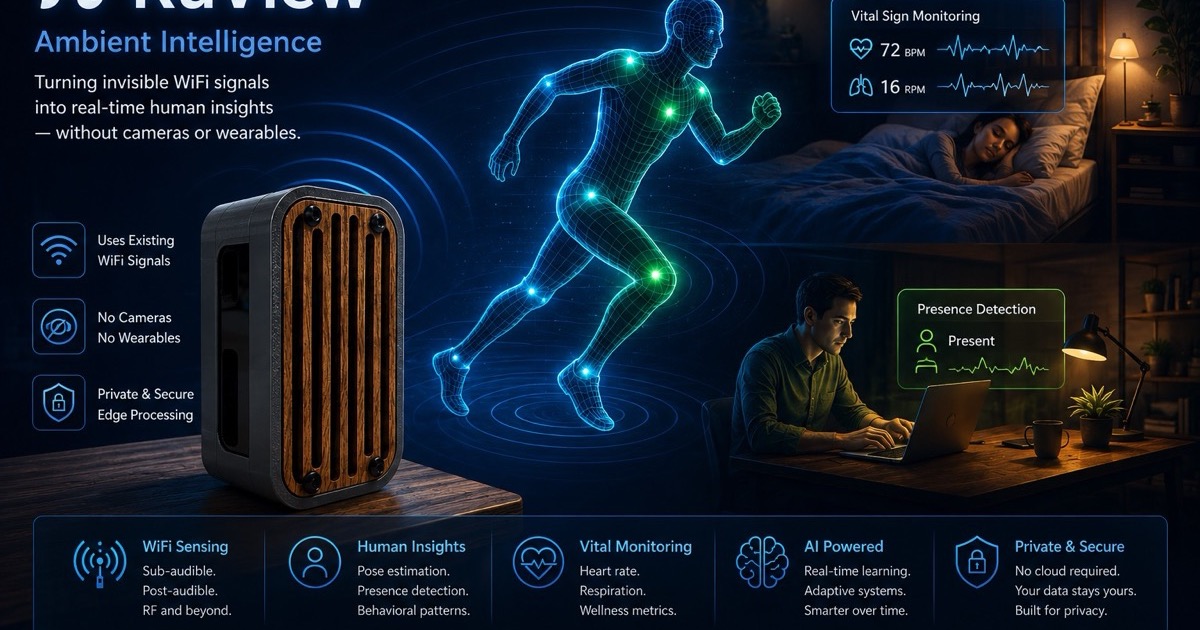
What if the router you already have at home could know if there is someone in the next room, measure their breathing while they sleep or estimate their body posture — without installing a single camera? That is the bet of RuView, an open source project that has accumulated more than 82,000 stars on GitHub and that converts WiFi waves into a presence, vital signs and movement sensor. It's not magic or science fiction: it's multipath physics, signal processing, and small neural networks running at the edge, on $9 chips.
Video: WiFi as radar that sees through walls
RuView project explained: CSI signals, 17-point pose, vital signs and fall detection without cameras or wearables. Source: YouTube — RuView / wifi-densepose
WiFi as a sensor, not as a camera
Each WiFi router saturates the space with radio waves. When a person moves, breathes, or simply sits, they alter those waves in measurable ways. RuView captures that information using CSI (Channel State Information) — subcarrier phase and amplitude data that modern WiFi chips can export — and transforms it into structured intelligence: who's there, what they're doing, and if they're OK.
The difference compared to a system with cameras is radical. There are no glasses to record faces, no microphones to capture conversations, no mandatory cloud to store video. Privacy is not a software setting: it is a consequence of the sensor. As the Cognitum page summarizes, RuView “skips the capture step” — there is no image or audio to edit afterwards.
What you can measure today
- Presence and occupancy: detect people through walls, count them and record entrances and exits.
- Contactless vital signs: respiratory rate (6–30 BPM) and heart rate (40–120 BPM) without bracelet or sensor in bed.
- Body pose: 17 COCO-style key points from radio signals; the WiFlow model achieves 92.9% PCK@20 in benchmarks with camera-supervised training.
- Activity and falls: walking, sitting, gestures and fall alerts with latency less than 200 ms.
- Multi-person counting: 3–5 people per access point, with min-cut graph algorithms to separate overlapping signatures.
- Through walls: multipath propagation and Fresnel zones allow detection behind partitions, furniture and even up to ~30 cm of concrete in rescue scenarios.
The team publishes figures with unusual honesty for a viral project: the v2 encoder reports 82.3% accuracy in held-out temporal triplets (up from 66.4% raw), and withdrew a previous figure of "100% presence" measured in a single class. Pose benchmarks in MM-Fi place the ruvnet/wifi-densepose-mmfi-pose model at 82.69% torso-PCK@20, above previous academic benchmarks.
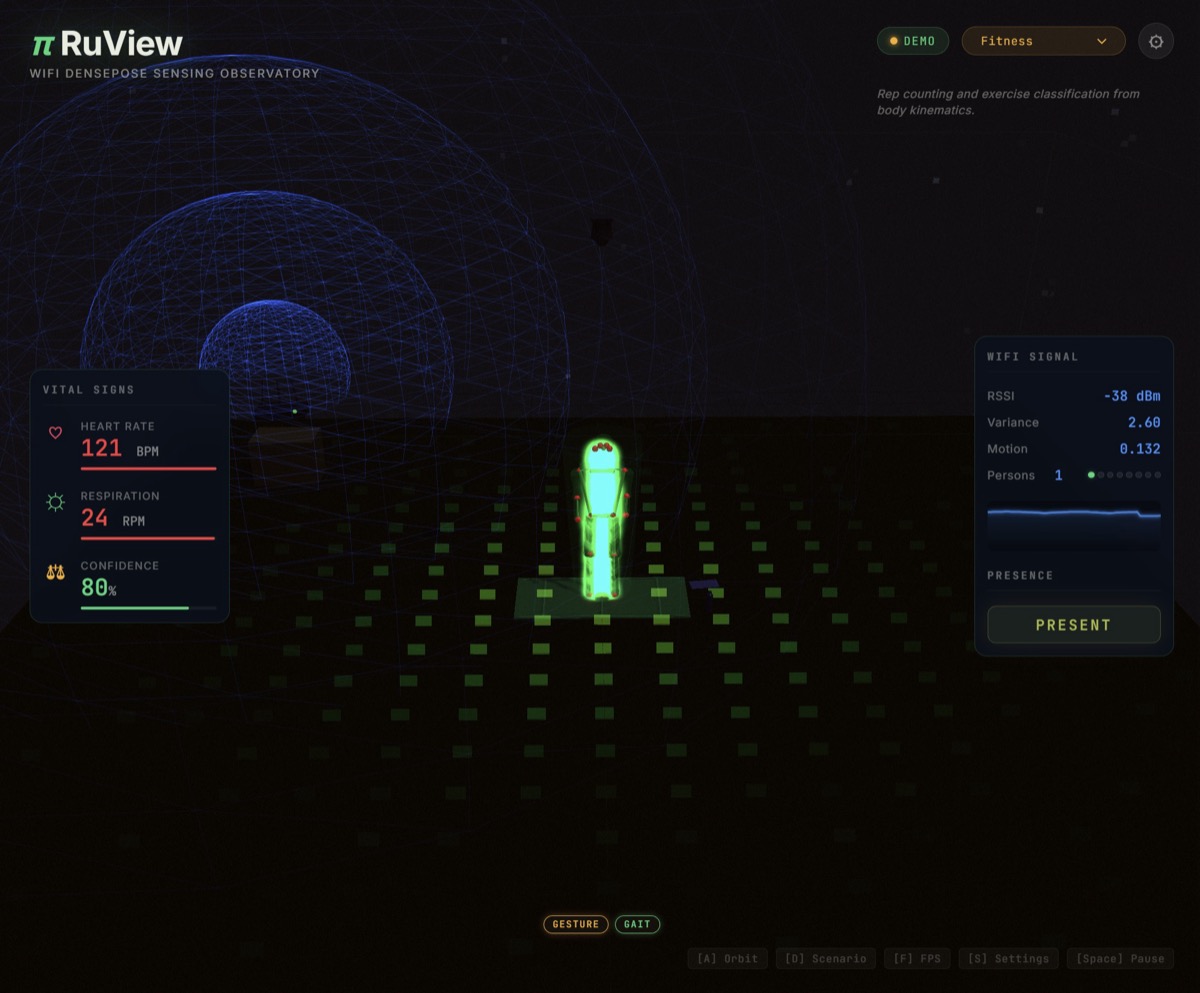
Hardware: from $9 to a complete appliance
RuView does not require a laboratory. The cheapest option is an ESP32-S3 (~$9) with CSI firmware; a mesh of 3–6 nodes and a WiFi router costs around $54. For persistent memory, cryptographic model signing, and integration with AI agents, Cognitum sells the Seed (pre-sale ~$257) and the v0 Appliance (~$991) with REST/WebSocket API on the local LAN.
Without hardware, you can evaluate the pipeline with Docker:
docker pull ruvnet/wifi-densepose:latest
docker run -p 3000:3000 ruvnet/wifi-densepose:latest
curl http://localhost:3000/health
There is also the Python package ruview in PyPI and pre-trained models downloadable from Hugging Face. The 4-bit quantized model occupies only 8 KB and runs in microseconds on a Raspberry Pi.
105 WASM modules at the edge
RuView is not a single monolithic model: it is a catalog of more than 105 modules (cogs) signed Ed25519 that run directly on the ESP32 — fall detection, sleep apnea, intrusion, HVAC control, retail queues, cobot proximity, etc. Each binary weighs between 5 and 30 KB. The open RVF format allows you to write your own modules in Rust or C.
Integration with smart home and AI agents
The project connects natively with Home Assistant (MQTT), Apple Home, Google Home, Alexa and Matter. It exposes REST APIs (/api/v1/sensing/latest, /api/v1/vital-signs, /api/v1/pose/current), real-time WebSocket and MCP tools for agents like Claude or Cursor to query presence and vitals without writing HTTP by hand.
Actual use cases (and limits)
Promoters highlight scenarios where cameras fail or are unacceptable: elder care and apnea, HVAC automation (15–30% typical energy savings), industrial safety in dust or smoke, retail without GDPR video, rescue under rubble (WiFi-Mat kit) and ambient presence in homes without wearables.
They also document what it does not do: facial recognition, forensic video capture, tracking in the open field without reflectors or movement at more than 10 m/s. The health modules are developer-preview; Regulated clinical uses (FDA, CE-MDD) require additional validation.
Why has it exploded on GitHub?
The combination is irresistible for developers: MIT code, reproducible benchmarks (python archive/v1/data/proof/verify.py), complete rewrite in Rust with speedups of up to 810× against Python v1, 1,463 passing tests, models in Hugging Face and a privacy by design narrative that contrasts with the wave of cameras and wearables with AI. The repository includes ESP32 firmware, sensing server, web dashboard, home automation integrations and extensive ADR documentation.
For MARGENEZ readers interested in gadgets and privacy, RuView is one of the most ambitious bets of 2026: converting existing WiFi infrastructure into a sensory fabric without asking permission from each user or installing a camera in the bathroom. The open question is not technical — the code is there — but deployment: will it work on your floor, with your walls and your router? The project itself admits that accuracy varies with the RF environment and offers local adaptation in less than 30 seconds per room.
Most read
What readers are engaging with right now.
- Culture
Goose, the gay app that competes with Grindr, reaches the top 4 of Lifestyle in the App Store
- World
Cubans protest in Miami against Airlines Connections for alleged scam: they demand up to $20,000 in packages to Punta Cana

- Culture
Harry Potter on HBO: complete guide to the series (not yet released and already renewed for T2), dates, cast and controversies

- World
Trump declares the ceasefire with Iran over, orders new attacks in Hormuz and demands cutting trade with Spain in NATO

- Culture
DUK App: Aly Sánchez launches her habits app "one day at a time" with a 63-day program
- Culture
I'm Edgy and Edgy Labs: From Nebraska's Walmart to a beef tallow cream brand that sells across the US.

- World
El Cangrejo: profile of Raúl Guillermo Rodríguez Castro, Raúl Castro's grandson between GAESA, leaked luxuries and the first interview of 2026
- World
Cuban regime terrorist Ramiro Valdés Menéndez dies

- World
Supreme Court, June 23, 2026: analysis of Tuesday's 5 rulings (and what each one implies)