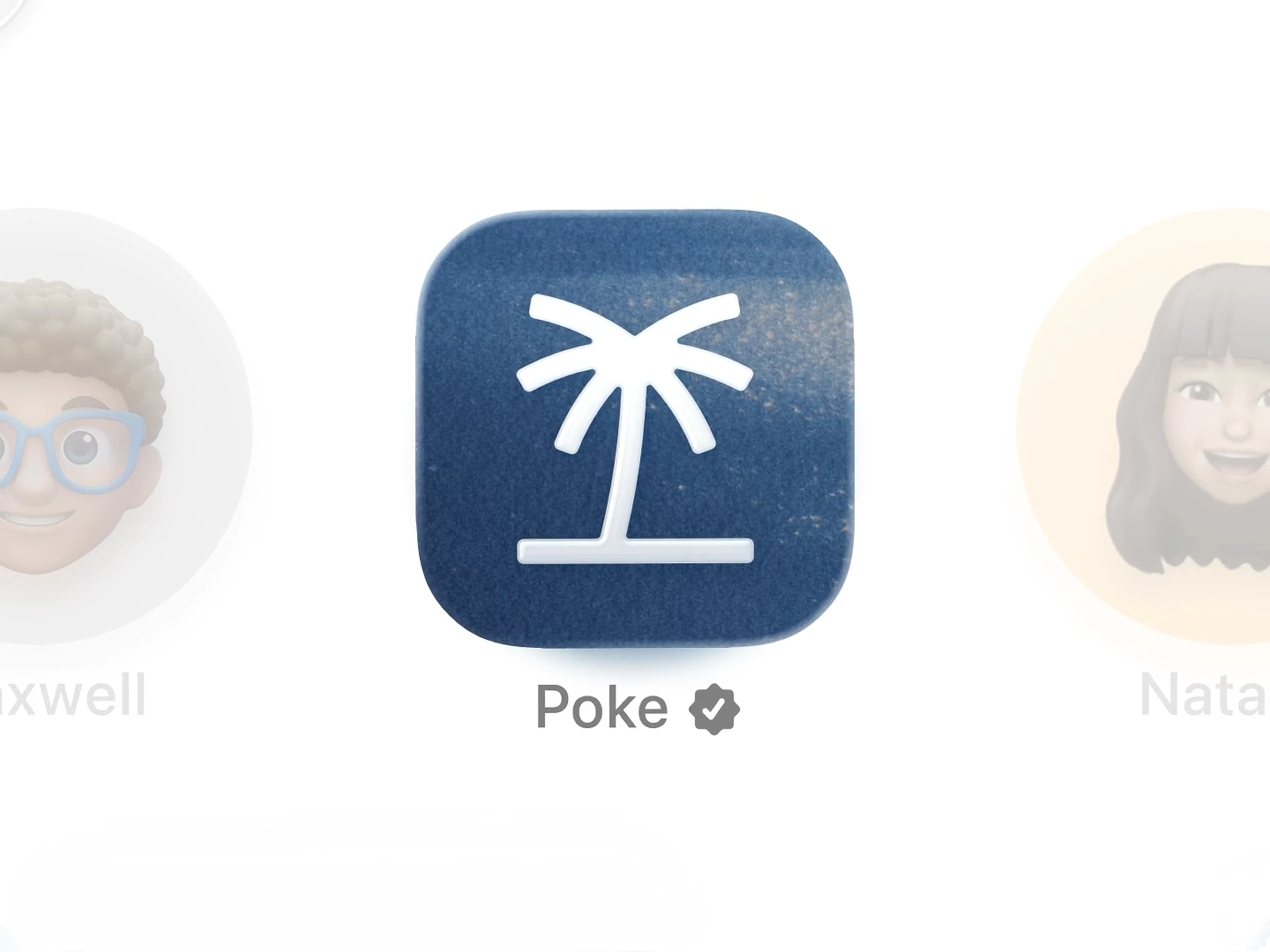
Poke has become the benchmark for a new category of artificial intelligence assistants: agents that live where we already talk, not in a separate app. Developed by The Interaction Company of California, based in Palo Alto, the service allows you to manage email, calendar, reminders, web searches and integrations with third-party services through text messages or voice notes. In June 2026, Apple approved it as the first third-party AI agent to operate within Apple Messages through the Messages for Business framework.
Demo: Poke in Apple Messages
The same video that appears on the cover of poke.com: verified chat and actions within Messages. Source: poke.com
Demo: Poke Ultra and websites
Interaction introduces Poke Ultra and website publishing at yourname.poke.com. Source: @interaction in X
Poke's bet is radical in its simplicity: there is no need to download another application. The user registers at poke.com, links their phone number and starts chatting. On iPhone, the conversation appears in Messages as a verified contact—just like a thread with a bank or airline—but with personal assistant capabilities. According to TechTimes, the startup had processed about 100 million messages before adding iMessage to your existing channels (SMS, Telegram and WhatsApp in some markets).
Apple Messages: the milestone that opens a door
Apple's approval, confirmed on June 4, 2026, came four days before WWDC, where a more conversational Siri was expected. For Poke, entering Messages for Business means accessing one of the most used surfaces on the iPhone without depending on an integration with Siri. AppleInsider highlighted that the agent can send emails, create reminders, generate images and run automations directly from the native messaging app.
It is important to clarify the mechanism: Poke does not access personal iMessage conversations. It operates through the business channel that Apple already controlled for companies to talk to customers. That distinction — pointed out by media such as Gadget Hacks— does not diminish the relevance of the milestone, but explains why Apple was able to approve it without "open" iMessage to any bot.
«Poke fits into your life, not the other way around. Integrate your apps with a familiar interface—Messages, WhatsApp, Telegram—and a personality that feels as real as a friend.»
What you can do: from Gmail to Oura
According to the official documentation at poke.com/docs, the assistant arrives prepared for everyday tasks: reading and writing emails, scheduling meetings, setting reminders and searching for information on the Internet. But its differential value is in the integrations. The product website highlights connectors with services such as:
- Gmail — search, compose and send emails with tag management.
- Notion — access and organize pages, databases and documents.
- Oura — view sleep, readiness, and ring activity metrics.
Users on networks have documented cases beyond the official catalog: analyzing food photos to record nutrition, controlling Philips Hue lights, searching for flights or posting notes on personal websites. Poke processes voice messages and can act proactively, alerting the user when it detects something relevant in connected services — for example, adding Granola action items to the calendar.
Poke Recipes and Poke Kitchen
Poke Recipes are reusable templates for setting up integrations, creating automations, and sharing settings with other users. They work like cooking recipes for the assistant: instead of explaining each step in each conversation, the user defines once how they want Poke to interact with their tools.
For developers, Poke Kitchen allows you to build more advanced recipes with custom integrations. It's the layer that turns Poke from a personal assistant to an extensible platform—similar in spirit to the MCP connectors that some users already combine with tools like PostHog.
Price plans: from free to $199
Poke structures its business on three levels, all accessible from poke.com:
The Ultra plan, announced as a novelty along with the Websites functionality - which allows Poke to publish content on personal pages - is aimed at users who want to delegate complete flows to the assistant. At $199 per month, it competes on price with premium subscriptions of other AI services, but relies on the convenience of the messaging channel and continuous proactivity.
A market that reacts before WWDC
Poke was released to the public in March 2026 and built up an active community on X before the integration with Apple. Figures like Geoffrey Litt have described stopping checking the mailbox manually because Poke notifies them by SMS of what is important; Other users compare it favorably to more technical agents like OpenClaw, noting that the barrier to entry is much lower.
The timing is not coincidental. With Apple strengthening its AI strategy in iOS 27 and opening – at least partially – Messages for Business to external agents, Poke is positioned as the first success story in a category that could multiply. If Apple formalizes this path with vetting criteria and explicit permissions, June 2026 will remain the month in which the iPhone stopped being just Siri's territory.
How to get started
Registration is available at poke.com for all regions, according to the official documentation. After linking the phone number, the user can start a conversation via Apple Messages, WhatsApp, Telegram or RCS. No credit card required for the free plan. For support, the company offers contact at poke@interaction.co.
Poke doesn't completely replace an operating system assistant—Siri still controls deep device settings—but it shows that millions of people prefer to delegate tasks to a trusted contact in Messages rather than open another app. In an ecosystem saturated with chatbots, that difference in interface can be the decisive advantage.
Most read
What readers are engaging with right now.
- Culture
Goose, the gay app that competes with Grindr, reaches the top 4 of Lifestyle in the App Store

- World
Cubans protest in Miami against Airlines Connections for alleged scam: they demand up to $20,000 in packages to Punta Cana

- World
Trump declares the ceasefire with Iran over, orders new attacks in Hormuz and demands cutting trade with Spain in NATO

- Culture
Harry Potter on HBO: complete guide to the series (not yet released and already renewed for T2), dates, cast and controversies

- Culture
DUK App: Aly Sánchez launches her habits app "one day at a time" with a 63-day program
- Culture
I'm Edgy and Edgy Labs: From Nebraska's Walmart to a beef tallow cream brand that sells across the US.

- Culture
The Evening of the Year VI: all the winners, fights and performances of the Ibai night in Seville

- World
The FBI is investigating the AFA for alleged fraud and money laundering: about $300 million in sponsorships and operations in the US.

- World
El Cangrejo: profile of Raúl Guillermo Rodríguez Castro, Raúl Castro's grandson between GAESA, leaked luxuries and the first interview of 2026