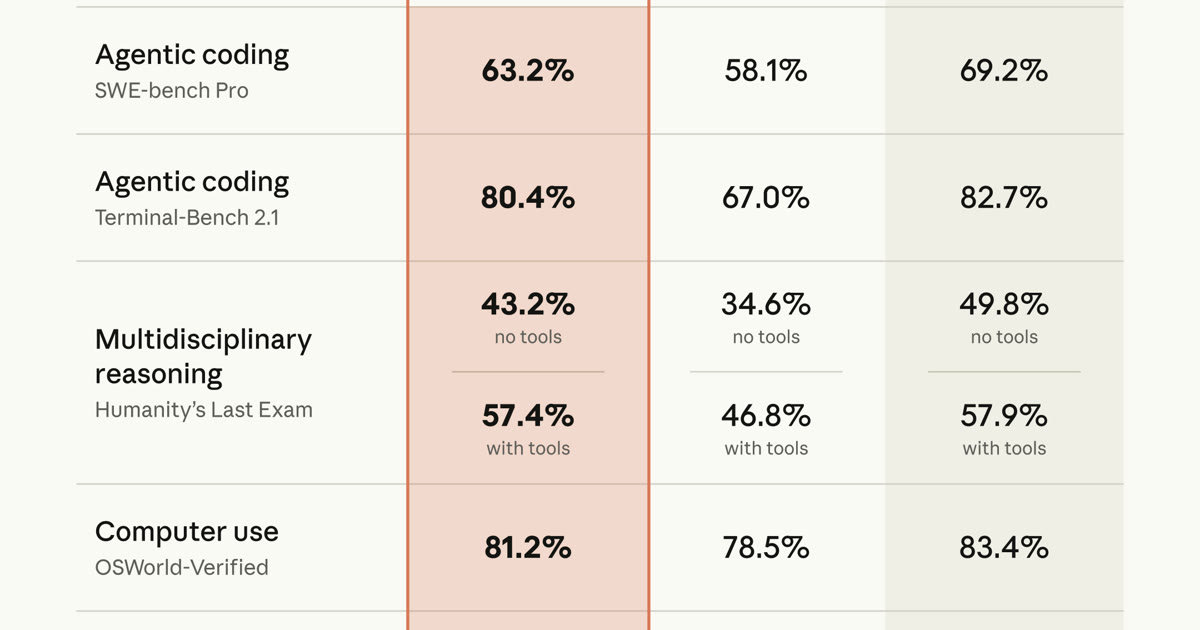
Anthropic closed on June 30 with two chain releases. In the afternoon, @claudeai presented Claude Sonnet 5 as “the most agentive Sonnet to date”: a model that plans, uses browser and terminal and executes autonomous tasks at a level that, according to the company, a few months ago demanded larger and more expensive models. Hours before, he had announced Claude Science, a research-oriented beta app. The official statement on anthropic.com sets the message: Sonnet 5 brings the performance of Opus 4.8 closer to mid-range prices.
Video: Anthropic presents Claude Sonnet 5
«Introducing Claude Sonnet 5, our most agentic Sonnet yet» — planning, tools and autonomy. Source: @claudeai — X (Jun 30, 2026)
What changes with Sonnet 5
In the launch thread, Anthropic defines Sonnet 5 as a leap in agent capabilities: the model makes plans, invokes tools (browser, terminal and others) and maintains long tasks without stopping as soon as previous Sonnet generations. The message fits with the evolution that the company itself describes: Sonnet 3.5–3.7 opened the door to coding and tool use; The biggest recent advances had been concentrated in Opus, and Sonnet 5 aims to close that gap.
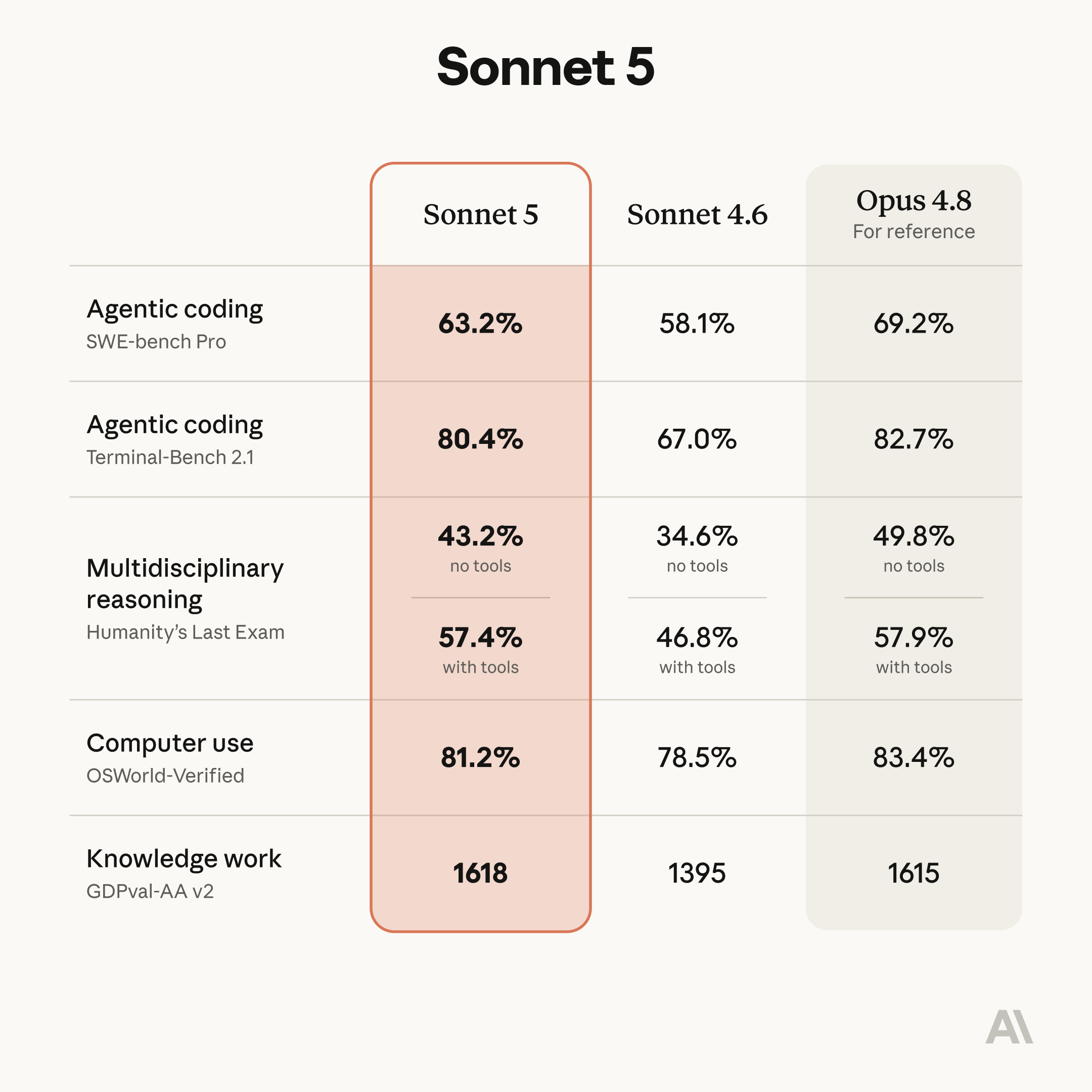
In a message in the same thread, Anthropic summarizes the leap over Sonnet 4.6 in reasoning, use of tools, programming and knowledge work, with performance “close to Opus 4.8, at lower prices. It also summarized @santtiagom_ in Spanish: better planning, better use of browser and terminal, better performance in long-term tasks and it became the default model for all Claude users.
Feedback from partners and real autonomy
Anthropic collects in its note and in another post in the thread early access testimonials: teams from Lovable, ClickHouse, Pace and others describe that Sonnet 5 finishes complex flows where previous Sonnets left off, checks its own output without being asked, and maintains conventions in multi-step changes. An example cited: updating tiers in Salesforce and sending an ad to enterprise contacts end to end—something that previously “stuck in the middle.”
Availability and prices
According to Anthropic, Sonnet 5 is already the default model in Free and Pro plans, and is available for Max, Team and Enterprise users. It reaches all Claude apps, Claude Code and the Claude Platform on the same day of the announcement.
In the API, the identifier is claude-sonnet-5. The official note details introductory price until August 31, 2026:
- Entry: 2 USD per million tokens
- Output: 10 USD per million tokens
Starting September 1, the standard price becomes 3 USD / 15 USD per million (in/out). Anthropic notes that Sonnet 5 uses an updated tokenizer compared to Sonnet 4.6: the same text can map to more tokens (approx. 1.0–1.35× depending on content); The introductory price seeks to make the transition “approximately cost-neutral.”
In agentic evaluations such as BrowseComp (search) and OSWorld-Verified (computer use), the company presents cost-performance curves where Sonnet 5 strictly improves on Sonnet 4.6; Opus 4.8 is still the most accurate option at the high end, but Sonnet 5 covers a more competitive intermediate range.
Claude Science, the other piece of the day
An hour before Sonnet 5, @claudeai announced Claude Science: an app designed “for each stage of research”, already in beta. It promises artifacts traceable to their code, on-demand managed environments, and more than 60 optional scientific databases to connect. Anthropic links it in its Sonnet 5 note as a related product for the researcher ecosystem.
Video: presentation by Claude Science
«Introducing Claude Science» — auditable artifacts, on-demand environments and 60+ connectable science bases. Source: @claudeai — X (Jun 30, 2026)
Security and safeguards
In the official note, Anthropic indicates that security evaluations place Sonnet 5 as overall more secure than Sonnet 4.6 in agentic contexts: better rejection of malicious requests, less hallucination and less misaligned behavior in automated audits. For offensive cybersecurity, Sonnet 5 shows less capability than Opus 4.8; It launches with cyber safeguards enabled by default, aligned with Opus 4.7 and 4.8.
In summary
What is it? Claude Sonnet 5, Anthropic's new agent-oriented medium model. Why does it matter? About Opus performance at Sonnet price and becomes the default of millions of users. When? Available June 30, 2026. API Price? 2/10 USD per million tokens until August 31; then 3/15. Extra? Claude Science in beta on the same day. For developers and teams that relied on Opus only for autonomy and tools, Sonnet 5 is the most relevant change to the Sonnet line since the 3.x models.
Most read
What readers are engaging with right now.
- Culture
Goose, the gay app that competes with Grindr, reaches the top 4 of Lifestyle in the App Store

- World
Cubans protest in Miami against Airlines Connections for alleged scam: they demand up to $20,000 in packages to Punta Cana

- World
Trump declares the ceasefire with Iran over, orders new attacks in Hormuz and demands cutting trade with Spain in NATO

- Culture
Harry Potter on HBO: complete guide to the series (not yet released and already renewed for T2), dates, cast and controversies

- Culture
DUK App: Aly Sánchez launches her habits app "one day at a time" with a 63-day program
- Culture
I'm Edgy and Edgy Labs: From Nebraska's Walmart to a beef tallow cream brand that sells across the US.

- Culture
The Evening of the Year VI: all the winners, fights and performances of the Ibai night in Seville

- World
The FBI is investigating the AFA for alleged fraud and money laundering: about $300 million in sponsorships and operations in the US.

- World
El Cangrejo: profile of Raúl Guillermo Rodríguez Castro, Raúl Castro's grandson between GAESA, leaked luxuries and the first interview of 2026