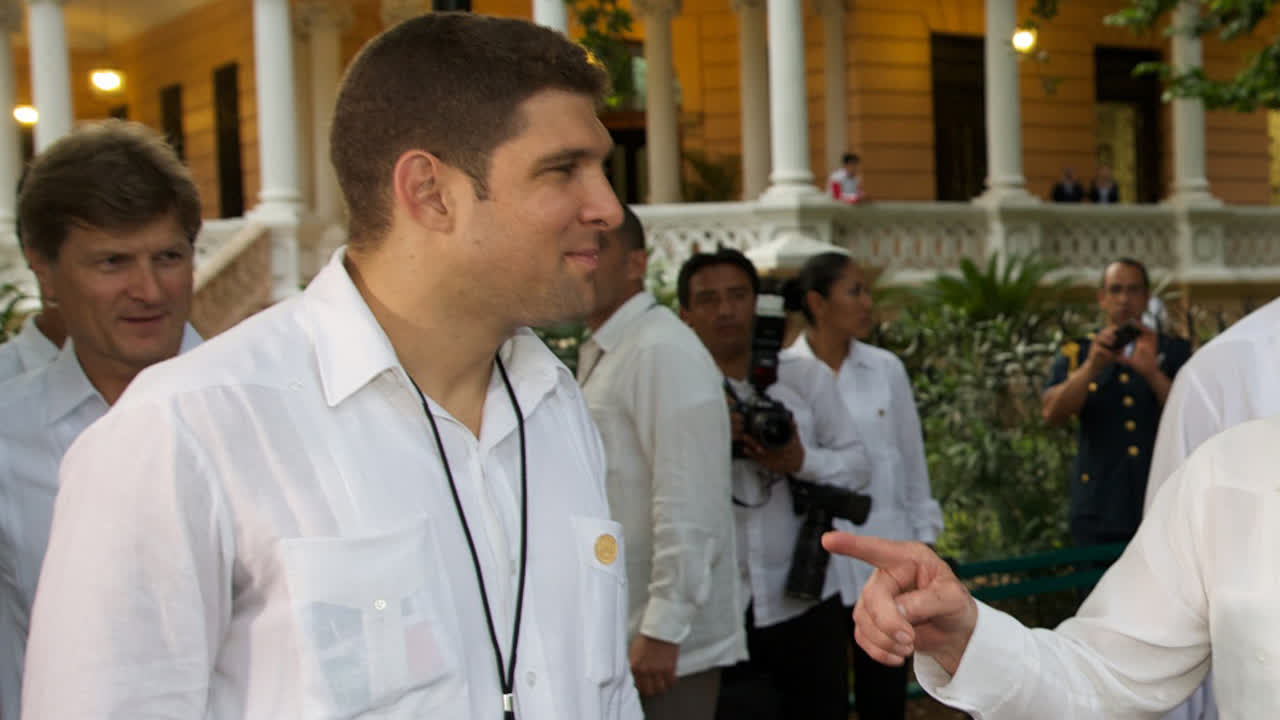
Guillermo del Toro Gómez (Guadalajara, October 9, 1964) is a Mexican filmmaker, author and artist whose work fuses fairy tales, gothic horror and empathy towards the marginalized. He considers monsters "symbols of great power" and has been a pioneer of dark fantasy in the global industry. His films combine Catholic imagery, practical effects, amber lighting and insects as metaphor. He is one of the Three Amigos of Mexican cinema along with Alfonso Cuarón and Alejandro González Iñárritu, and the first filmmaker to win an Oscar for best film, best direction and best animated film.
Childhood and first steps
Son of Guadalupe Gómez Camberos and Federico del Toro Torres, an automotive businessman, he grew up in Guadalajara in a strictly Catholic home. In 1969 his father won a lottery that allowed him to be raised "among books and exotic animals"; He himself has described the family home as "an enchanted castle." At the age of eight he began experimenting with his father's Super 8 camera: one of his first shorts was about a "serial killer potato" that ends up crushed by a car.
He studied at the Center for Research and Cinematographic Studies of the University of Guadalajara. He learned special effects from Dick Smith, worked for ten years as an effects makeup artist and founded the company Necropia. He also co-founded the Guadalajara International Film Festival and participated in the cult series La Hora Marcada alongside Alfonso Cuarón and Emmanuel Lubezki.
Early career: from Cronos to Pan's Labyrinth
His first planned feature film, Omnivore (stop-motion about a lizardman), was destroyed when vandals vandalized the sets. Del Toro pivoted to Cronos (1993), a tale of mechanical vampirism that won the Camera d'Or at Cannes. After the conflictive experience with Miramax in Mimic (1997), he returned to Spanish-language cinema with two masterpieces set in the Civil War:
- The Devil's Backbone (2001): ghost drama in an orphanage during the post-war period.
- Pan's Labyrinth (2006): 6 Oscar nominations and 3 wins: production design, photography and makeup. Del Toro was nominated for original screenplay, but did not win in that category. Ofelia and the Faun became icons of 21st century cinema.
Hollywood and franchises
At the same time, del Toro directed genre films in English: Blade II (2002), Hellboy (2004) and Hellboy II: The Golden Army (2008), Pacific Rim (2013) — box office of 411 million — and Crimson Peak (2015). He was hired to direct The Hobbit, but abandoned the project in 2010 due to financial delays at MGM; He remains credited as a co-author on the trilogy. He also produced or wrote The Orphanage (2007), Mamá (2013), The Book of Life (2014) and Scary Stories to Tell in the Dark (2019).
The shape of water and absolute triumph
The Shape of Water (2017) gave him the Golden Lion in Venice — the first Mexican to win as best film — and four Oscars: film, direction, soundtrack (Alexandre Desplat) and production design. It is his most optimistic film: a romantic fable about a mute cleaner and an amphibious creature in the middle of the Cold War.
Nightmare Alley (2021), a traveling carnival noir with Bradley Cooper and Cate Blanchett, received four Oscar nominations but failed at the box office. In between, he created the anthology Guillermo del Toro's Cabinet of Curiosities (Netflix, 2022) and the animated franchise Tales of Arcadia.
Pinocchio and Frankenstein: closing the circle
After fifteen years of development, Guillermo del Toro's Pinocchio (2022) — stop-motion co-directed with Mark Gustafson — won the Oscar for best animation in 2023. Del Toro pronounced on stage: “Animation is cinema, it is not a genre.”
Frankenstein (2025), his adaptation of Mary Shelley for Netflix with Oscar Isaac and Jacob Elordi, closed what the director describes as his "Gothic cycle" (Cronos → The Backbone → The Labyrinth → Crimson Peak → Frankenstein). Premiered at Venice 2025, it received 9 Oscar nominations and won in production design, costumes and makeup.
Video: speech at the 2023 Oscars (Pinocchio)
«Animation is cinema. Animation is not a genre»: del Toro when collecting the Oscar for Pinocchio, his third statuette. Source: Oscars — YouTube
Video: official trailer for Frankenstein (2025)
Frankenstein (2025), the closing of del Toro's Gothic cycle: Oscar Isaac, Jacob Elordi and nine Oscar nominations. Source: Netflix — Frankenstein Official Trailer
Filmography as a director
| Year | Title | Notes |
|---|---|---|
| 1993 | Cronos | Debut; Camera d'Or (Cannes) |
| 1997 | Mimic | First English language film |
| 2001 | The Devil's Backbone | Spanish Civil War |
| 2002 | Blade II | Marvel Universe (New Line) |
| 2004 | Hellboy | Comic by Mike Mignola |
| 2006 | Pan's Labyrinth | 3 Oscar (production design, photography, makeup) |
| 2008 | Hellboy II: The Golden Army | — |
| 2013 | Pacific Rim | Kaiju vs. jaegers |
| 2015 | Crimson Peak | Romantic Gothic |
| 2017 | The Shape of Water | 4 Oscar · Golden Lion |
| 2021 | Nightmare Alley | 4 Oscar nominations |
| 2022 | Guillermo del Toro's Pinocchio | Oscar for best animation |
| 2025 | Frankenstein | 3 Oscar · Netflix |
Notable productions and scripts
- The Orphanage (2007): executive producer; debut feature by J.A. Bayona, 7 Goya.
- Don't Be Afraid of the Dark (2010): co-author and producer.
- The Hobbit (2012–2014): co-author (trilogy).
- Mamá (2013): producer.
- The Book of Life (2014): producer.
- Pacific Rim: Uprising (2018): producer.
- Scary Stories to Tell in the Dark (2019): producer.
- The Witches (2020): executive producer (remake).
Television, books and other media
- The Strain (2009–2011): trilogy of vampire novels with Chuck Hogan; adapted to comic and FX series (2014–2017).
- Trollhunters / 3Below / Wizards: animated universe Tales of Arcadia (Netflix/DreamWorks).
- Cabinet of Curiosities (2022): horror anthology for Netflix.
- Video games: collaboration with Hideo Kojima in P.T. (cancelled) and cameo in Death Stranding (2019).
- Exhibition: Guillermo del Toro: At Home with Monsters toured LACMA, Minneapolis and Toronto (2016–2018).
Main awards (as director)
| Movie | Oscar (nom / gan) | BAFTA | Golden Globe |
|---|---|---|---|
| Pan's Labyrinth | 6 / 3 | 8 / 3 | 1 / 0 |
| Hellboy II | 1 / 0 | — | — |
| Pacific Rim | 1 / 0 | — | — |
| The Shape of Water | 13 / 4 | 12 / 3 | 7 / 2 |
| Nightmare Alley | 4 / 0 | 3 / 0 | — |
| Pinocchio | 1 / 1 | 3 / 1 | 3 / 1 |
| Frankenstein | 9 / 3 | 8 / 3 | 5 / 0 |
In total he has three Oscars in his own person (two for The Shape of Water and one for Pinocchio), in addition to three BAFTAs, two Golden Globes, a daytime Emmy and a Golden Lion in Venice. Pan's Labyrinth added three more Oscars for its technical team. Time included him among the 100 most influential people in the world in 2018; He received his star on the Hollywood Walk of Fame in 2019.
The Three Amigos and legacy
Del Toro, Cuarón and Iñárritu share friendship, cross-production and a generation that brought Mexican cinema to the center of Hollywood. Cuarón produced Pan's Labyrinth; Iñárritu helped with the assembly. The three founded Cha Cha Cha Films and have alternated triumphs at festivals and awards for two decades.
His aesthetic — compassionate monsters, authoritarianism as a recurring villain, the grotesque made beautiful — has influenced Bayona, Muschietti and a whole wave of fantastic cinema in Spanish. In 2023 he announced The Buried Giant (stop-motion with Netflix) and declared that, after a couple more live-action projects, he wants to dedicate himself above all to animation.
Personal life
He was married to Lorenza Newton (1986–2017), with whom he had two daughters. In 2021 he married film historian Kim Morgan. He maintains residences in Toronto and Los Angeles and returns to Guadalajara every few weeks. He collects books, poster art and models in two houses dedicated exclusively to his creative archive.
Related articles in MARGENEZ
Most read
What readers are engaging with right now.
- Culture
Goose, the gay app that competes with Grindr, reaches the top 4 of Lifestyle in the App Store

- World
Cubans protest in Miami against Airlines Connections for alleged scam: they demand up to $20,000 in packages to Punta Cana

- World
Trump declares the ceasefire with Iran over, orders new attacks in Hormuz and demands cutting trade with Spain in NATO

- Culture
Harry Potter on HBO: complete guide to the series (not yet released and already renewed for T2), dates, cast and controversies

- Culture
DUK App: Aly Sánchez launches her habits app "one day at a time" with a 63-day program

- Culture
I'm Edgy and Edgy Labs: From Nebraska's Walmart to a beef tallow cream brand that sells across the US.

- Culture
The Evening of the Year VI: all the winners, fights and performances of the Ibai night in Seville

- World
The FBI is investigating the AFA for alleged fraud and money laundering: about $300 million in sponsorships and operations in the US.

- World
El Cangrejo: profile of Raúl Guillermo Rodríguez Castro, Raúl Castro's grandson between GAESA, leaked luxuries and the first interview of 2026