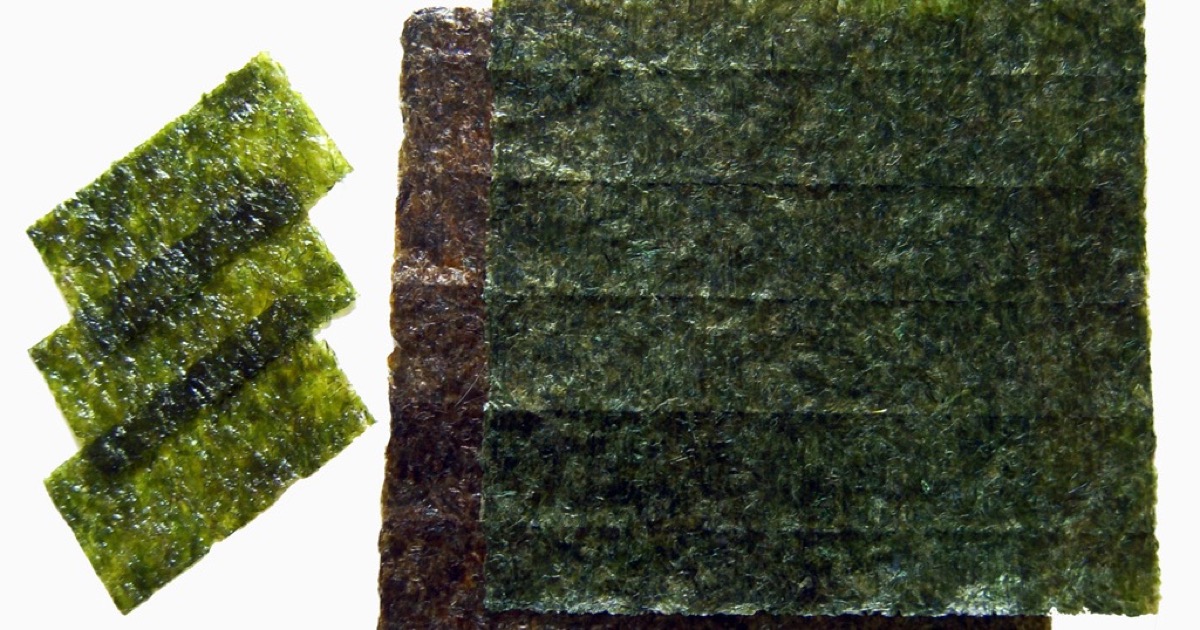
Toasted organic seaweed sheets—the nori snack you see on TikTok, in the Asian supermarket, and in the “healthy” basket—are not a passing whim. They are a product with centuries of tradition in Japan and Korea that is today industrialized on a global scale: crops in the ocean, thin layers like washi paper and a seconds roast that turns the seaweed into something crunchy, salty and difficult to put down. We tell you what it is, how it is made and why it is so engaging.
What exactly they are
It is a food made from red algae, mainly the species Pyropia yezoensis, commercially known as nori. After harvesting, the seaweed is processed into very thin sheets and roasted until it obtains a brittle texture and a distinct umami flavor. In sushi it is the green wrapper; in snack format it arrives in individual packets, often with a light touch of sesame oil and sea salt.
According to Oriental Mart and Seaweed with Manu, nori provides marine minerals, vegetable protein and that saline profile that differentiates it from other ultra-processed snacks.
Origin and history: from Edo to the «Mother of the Sea»
The consumption of seaweed in Japan is not a recent trend: Documents and culinary traditions place it back more than 1,300 years. For centuries they were eaten in different forms—loose leaves, pasta or seasoning—, but the thin, crunchy rectangular sheet that you recognize today in sushi and snacks is a much later invention.
Who invented the sheet format
According to the historiography of nori collected in Wikipedia and specialized sources such as Yamamotoyama, the sheet format was consolidated around 1750 in the district of Asakusa, in Edo (the old Tokyo). Local artisans did not start from scratch: they adapted the method of Japanese washi paper—shredding fiber, spreading it in molds and drying it into thin sheets—to the processing of seaweed.
This technical leap explains why industrial nori still resembles edible paper: the seaweed suspension is poured into squares, pressed, dehydrated and only then toasted. The snack you buy today directly inherits that logic of the 18th century.
Kathleen Mary Drew-Baker and modern cultivation
Having sheets was not enough to supply an entire country. During the 19th and early 20th centuries, Japanese nori production depended on unpredictable wild harvests: bad seasons ruined fishermen and manufacturers alike. The industry needed to understand how the algae reproduced to plant it in a controlled way.
The missing piece came from afar. The British botanist Kathleen Mary Drew-Baker (1901-1957) studied on the Lancashire coast the life cycle of Porphyra—a direct relative of the algae that is now cultivated as nori—and published in 1949 how the sexual and asexual phases of the organism alternated. Japanese scientists, especially Segawa Sokichi, applied this knowledge to local species and developed artificial seeding on nets in the sea.
The impact was so great that in Japan she is remembered as the "Mother of the Sea" (Umi no okāsan, 海のお母さん): every April 14 a commemorative day is celebrated in her honor at the Sumiyoshi Shrine in Fukuoka. Encyclopaedia Britannica summarizes its legacy as the bridge between Western marine philology and Japanese aquaculture that today produces billions of plates a year.
Without the discovery of reproductive cycle of the seaweed, modern nori—cultivated, stable, and affordable—probably would not exist as we know it.
Production process: from the sea to the bag
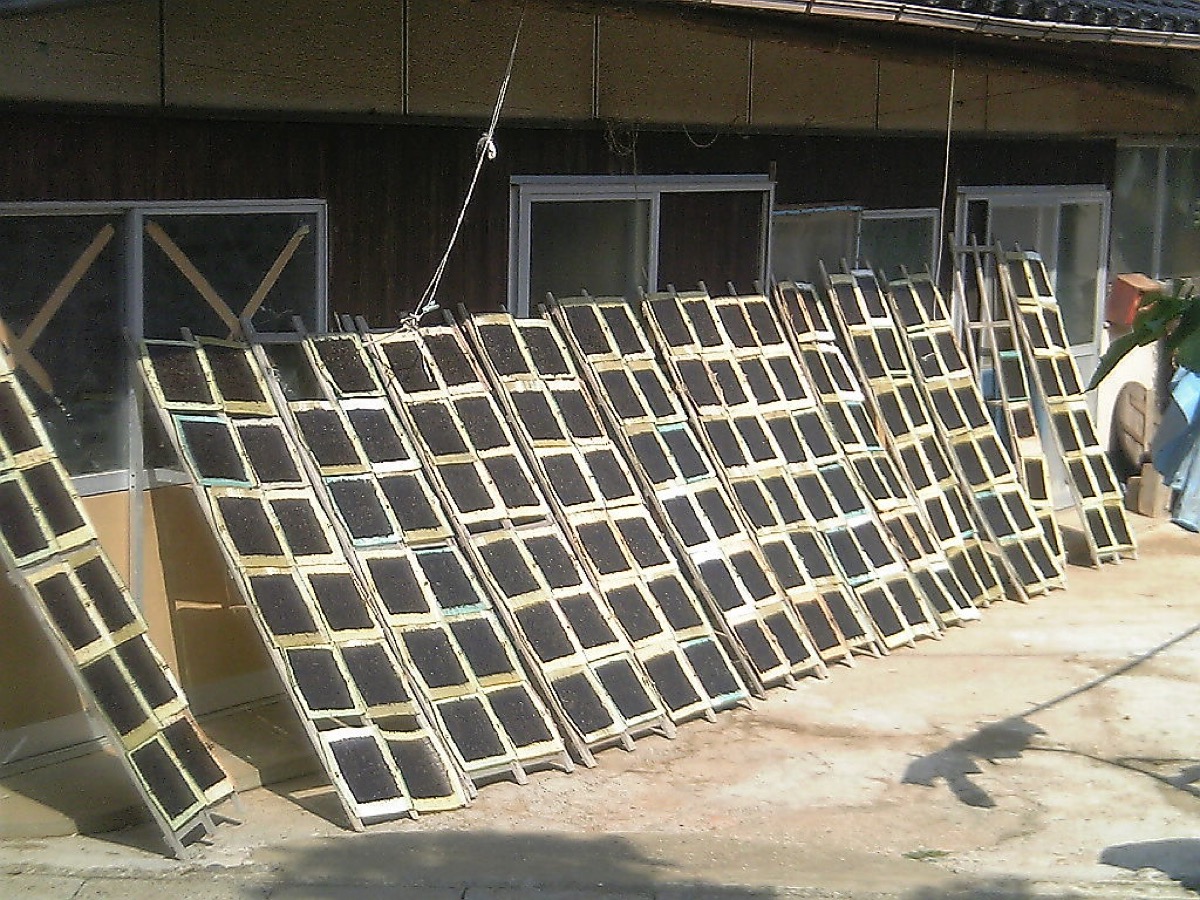
Industrial manufacturing —documented by Muy Japones, Yamamotoyama and Fine Dining Lovers— partly recalls the production of Japanese washi paper: uniform layers, controlled drying and a finish that defines texture and flavor.
- Cultivation. Algae spores are sown in nets suspended in the ocean during the cold months (autumn and winter), when the water temperature favors growth.
- Collection and cleaning. When mature, it is harvested and washed with mixtures of fresh and sea water to remove impurities, sand and excess salt.
- Crushed and formed. The seaweed is chopped to form a paste or suspension that is poured into square molds to create sheets of uniform thickness.
- Dried and roasted. The layers pass through heat tunnels. Roasting—approximately 12 seconds—is the decisive step: it activates aromatic compounds, enhances umami and sets the intense green color and the texture that melts when you bite.
- Flavoring. In commercial snacks, a thin layer of oil (sesame or olive) and sea salt is applied before or after final roasting.
Video: how toasted seaweed snacks are made
Source: YouTube
To see the cultivation in marine networks, this documentary shows the harvest and the process on the farm: cultivation and harvesting of nori on YouTube.
Why they are so famous now
Their boom in networks and on shelves coincides with the superfood label: a lot of nutrients in few calories. Vogue México and several nutrition guides highlight a profile rich in iodine (key for the thyroid), fiber, plant-quality proteins, omega-3, antioxidants and vitamins A, B and C.
Among the benefits that are often cited – always in moderation in consumption – are support for the immune system, digestion, a satiating effect useful in weight control diets and the ability of algae to bind and help eliminate some toxins and metals heavy in the body. That's why many nutritionists recommend organically grown versions, grown in controlled environments with less risk of marine contaminants.
| Nutrient / trait | Why it matters |
|---|---|
| Iodine | Essential for thyroid hormones; nori is one of the most concentrated plant sources |
| Protein + fiber | Satisfying with few calories; light alternative to the classic fried snack |
| Omega-3 | Marine fatty acids in vegetable format |
| Antioxidants | Phenolic compounds and pigments from red algae |
| Low calories | A sheet provides very little energy compared to chips or cookies salty |
Why are they “addictive”?
The feeling of not being able to stop eating them is no coincidence. Nori concentrates natural glutamate, the compound behind umami—the fifth flavor—that stimulates taste receptors and generates immediate satisfaction. Added to this is the crunchy texture, salt and sesame oil: a combination that activates sensory reward mechanisms similar to those of other processed snacks, but with a generally more favorable nutritional profile.
Algas con Manu and production documentaries shared on networks —like the one compiled by Design Insider—have helped make the process go viral: seeing how a net in the sea ends up in a crunchy bag is hypnotic and reinforces the perception of a “smart snack”.
How it looks in the supermarket: brands and formats
Outside of Japan and Korea, toasted nori is no longer just a sushi ingredient: it is a shelf snack with vertical packaging, health claims on the cover and individual sheets inside sealed envelopes to preserve the crunch. The visual pattern is repeated: light background, photo of stacked dark green sheets, USDA Organic or Non-GMO seals and messages of low calories or net carbohydrates.
Formats you will find
- Mini packs (5–10 sheets of ~5 g): the most widespread “snack” format on TikTok and in supermarket checkouts.
- Big sheets(large sheets, ~20–26 g): designed for rolling rice, wraps, or eating in bites; the packaging is usually wider.
- Sushi leaves (10–50 units, unflavored or with minimal salt): kitchen product, not a snack, but the same base seaweed.
- Flavored varieties: sea salt, wasabi, sesame, chili, teriyaki or olive oil depending on the market.
Best known brands
In the United States and Western Europe, brands stand out that packaged nori as a “healthy snack” before large local distribution:
| Brand | Origin / profile | What usually sells |
|---|---|---|
| gimMe (Gimme Health Foods) | USA. USA; one of the pioneers in organic nori on the Western shelf | Roasted Seaweed Snacks, Big Sheets (Wrap N Roll), Sea Salt, Teriyaki and Wasabi varieties |
| SeaSnax | USA. USA; organic and clean approach | Mini packs of toasted nori with sea salt or lemon |
| Annie Chun's | Asian-American brand very visible in supermarkets | Seaweed Snacks in various flavors; also noodles and sushi kits |
| Wang / Daechun | South Korea; strong presence in Asian stores | Toasted sheets in familiar and economical formats |
| Bibigo (CJ Foods) | Korea; global Korean food brand | Seaweed snacks and ready-to-eat products |
| Yamamotoyama | Japan; historic manufacturer since the 17th century | Premium toasted nori sheets for sushi and snacks |
| Kirkland Signature (Costco) | High-volume own brand | Competitively priced multipack boxes of toasted nori |
| Trader Joe's | Own brand in the USA. USA | Wasabi Roasted Seaweed Snack and similar formats |
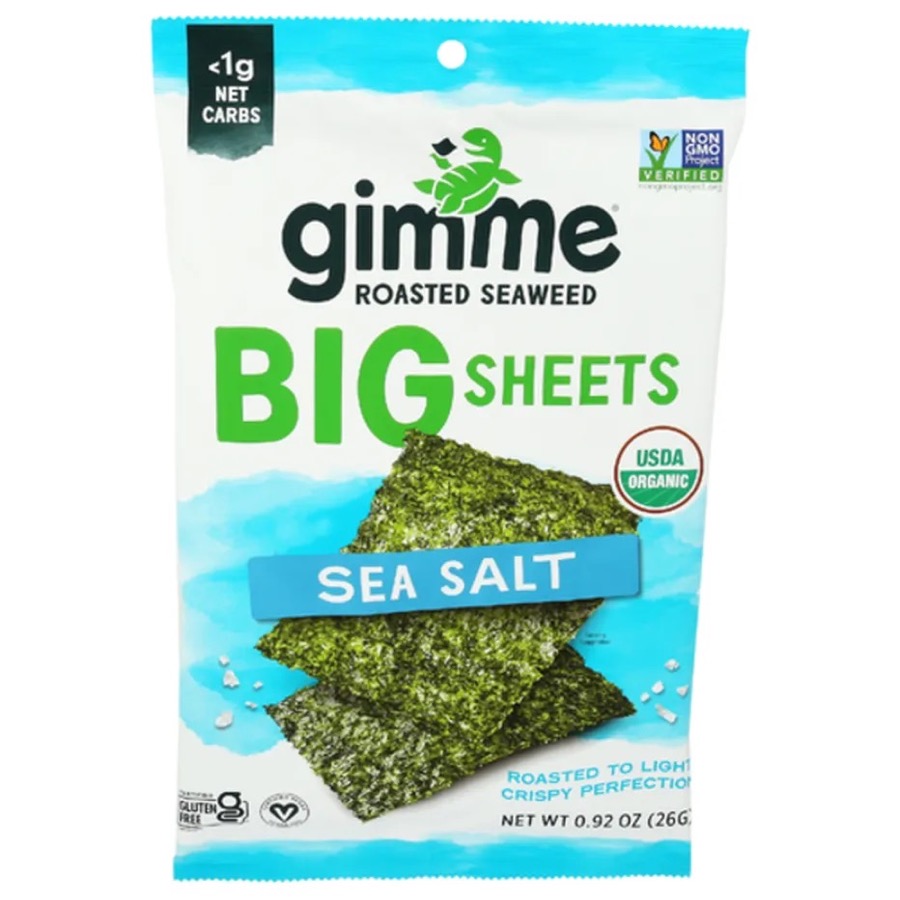
The example of gimMe—with its reading turtle and the label “Roasted to light crispy perfection”—illustrates how an ancient tradition is sold today: as an organic, gluten-free snack, low in carbohydrates and ready for the Western supermarket cart. It is not the only design on the market, but it is one of the most recognizable if you are looking for nori outside of a specialized Asian store.
How to store them: fridge or pantry?
It is one of the most common mistakes: since "it's food", many people put nori in the refrigerator along with the rest of the "healthy" snacks. In practice, the roasted and dehydrated product is designed to live in a cool, dry and dark place—such as a pantry cupboard or a kitchen drawer away from the stove—not in a humid environment.
Why avoid the refrigerator? When you open the door, condensation enters: cold, humid air penetrates the container, the sheets absorb moisture and within minutes they lose their crunch. Even worse if you keep the opened package inside: every time you take it out, the change in temperature accelerates the softening. Manufacturers (including gimMe) recommend dry storage; Only after opening should you consume it promptly or close the inner envelope tightly.
| Situation | What to do |
|---|---|
| Package unopened | Pantry or closet, room temperature, away from direct sunlight and the kitchen |
| Package open | Close the inner envelope; optional: airtight bag with a silica bag if you live in a very humid area |
| Impulse to put it in the refrigerator | Avoid it: humidity ruins the texture; it does not gain in food safety if the product is dry and sealed |
| Sheets are already soft | Use them in soups, rice or stir-fries: the heat rehydrates them; They are no longer valid as a crunchy snack |
Can you eat nori every day? Several times a day?
As a superfood, nori concentrates nutrients in a small volume—especially iodine, fiber, protein and marine minerals. That's an advantage in moderate portions and a risk if you overdo it. In Japan and Korea it is part of the usual diet (sushi, soups, onigiri) without problem; the balance depends on how much you eat and your individual health.
What is usually safe
For a healthy adult without thyroid problems, one or two mini packs a day (about 5–10 g of dried seaweed in total) is usually within reason, as long as the rest of the diet is not extremely salty. One sheet provides very few calories; The "danger" is not gaining weight, but rather accumulating iodine and sodium without realizing it if you open the third or fourth package in a row. If you take medication or have nodules, ask your doctor before eating nori daily.
In summary: eating nori daily does not "poison" itself, but eating it many times a day for weeks without control can alter thyroid function (due to excess iodine) or increase salt intake. Treat it as a nutritious snack, not a substitute for vegetables or a complete meal. If you already eat it frequently and have thyroid symptoms or concerns, a simple test and medical opinion will clarify the picture.
How to choose and consume them
- Look for organic or traceable labels if you are concerned about heavy metals.
- Check the sodium: some brands go from light flavoring to high amounts of salt.
- Store them in a dry place, not in the refrigerator: the humidity softens them in minutes.
- Combine them with rice, salads or soups if you prefer to use them as an ingredient and not just as a snack.
- If you eat more than one package a day, distribute your intake and watch iodine and salt in the rest of your meals.
Toasted seaweed sheets do not replace a balanced diet, but they explain a large part of the rise of the "sea snack": Asian tradition, accessible food science and a flavor that the brain asks to repeat. If you haven't tried them yet, start with a simple package of salt-toasted nori—and see if you, too, fall into the umami loop.
Most read
What readers are engaging with right now.
- World
Cubans protest in Miami against Airlines Connections for alleged scam: they demand up to $20,000 in packages to Punta Cana

- Culture
Goose, the gay app that competes with Grindr, reaches the top 4 of Lifestyle in the App Store

- Culture
Harry Potter on HBO: complete guide to the series (not yet released and already renewed for T2), dates, cast and controversies

- World
Trump declares the ceasefire with Iran over, orders new attacks in Hormuz and demands cutting trade with Spain in NATO

- Culture
DUK App: Aly Sánchez launches her habits app "one day at a time" with a 63-day program

- Culture
I'm Edgy and Edgy Labs: From Nebraska's Walmart to a beef tallow cream brand that sells across the US.
- World
El Cangrejo: profile of Raúl Guillermo Rodríguez Castro, Raúl Castro's grandson between GAESA, leaked luxuries and the first interview of 2026

- World
The FBI is investigating the AFA for alleged fraud and money laundering: about $300 million in sponsorships and operations in the US.

- World
Cuban regime terrorist Ramiro Valdés Menéndez dies